Learn Stock Trading
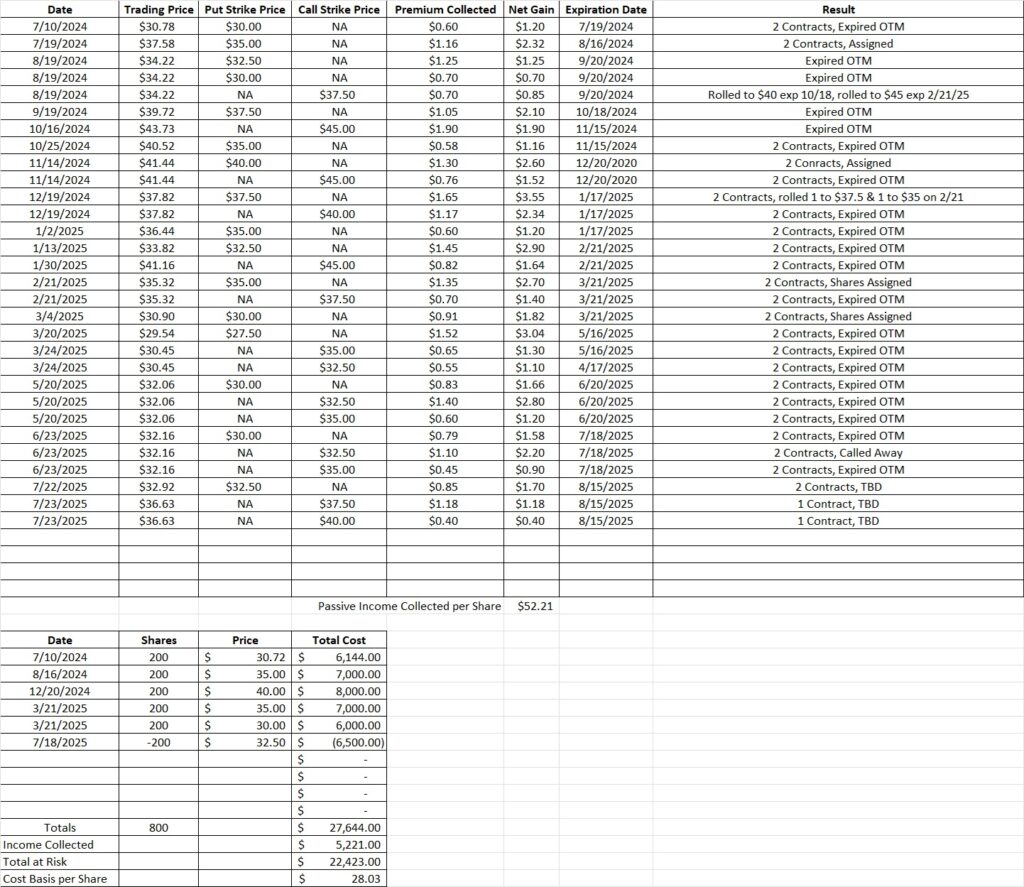
Today we’re going to walk through a way to learn stock trading. We’ve been trading MBUU for about a year and we’ve built a position of 1,000 shares. Our cost basis on those shares is down to $29.25 per share. We’ve used tranches to enter our position, and most of our shares have come on cash secured put option contracts. A person beginning the process to learn stock trading may find this post on the importance of using tranches helpful.
Last month we had two contracts of the $30 put option contract and two contracts of the $32.50 call option. This post walks through how we entered into those trades to create passive income. MBUU ran up through our call strike early in the month, then pulled back to end the period at $32.91. That meant our covered call option contracts were in the money. So we sold 200 of our shares at $32.50 per share, and that gave us $6,500. Since we had bought that tranche at $30 per share, we had a net gain of $2.50 per share on the sale. We also had the option income we entered into those contracts.
Now we have 800 shares of MBUU in this portfolio and we have room to add another tranche. We’re going to sell some cash secured put option contracts to create some cash flow. The premium from entering into those options trades will reduce our basis per share. When we sell to open a put option contract we’re making a promise to buy shares of the company at the put strike. Since each contract is for 100 shares, we need to have at least 100 times the strike price available in our brokerage account for each put option contract we sell. Int his case we’re selling the $32.50 strike for the 8/15 expiration date. We’re only entering into these put options here because we’re happy buying more shares of MBUU in this price range. Let’s walk through how we evaluate this option contract.
When we learn stock trading there are several factors to consider when we select an expiration date. One factor is the amount of premium we’ll receive when we sell to open the contract. Another is if there are major news announcements that are coming up. One such news announcement is the quarterly earnings call. MBUU has not yet announced when their earnings call will take place. Last year their call for the quarter ended 6/30 was on 8/29. We find that information by looking at the Investor Relations section of the company’s website. We can see that here.
Another factor we want to consider is the Federal Open Market Committee meeting calendar. Their next meeting is coming up next week. Here is a link to their calendar. In addition to the traditional focus of employment levels and inflation, the FOMC also has to deal with the Trump administration. Even though Trump appointed Powell, Trump has been critical of Powell’s approach. Powell has remained data driven when deciding whether to cut interest rates. Trump is pressuring Jerome Powell to reduce interest rates. The Federal Open Market Committee is supposed to be independent from political influence. Past presidents have respected the expertise and independence of the FOMC. That is not the case with the Trump administration.
We want our return on the capital we risk on a put option contract to generate an acceptable rate of return when we learn stock trading. Yesterday was 7/22 and the next available expiration date for options on MBUU is 8/15. That means our contract will be active for 24 days. Then we compare that time period to the number of times we could do a similar trade over the course of a year. So we divide the 365 days that are in a year by the 24 days this trade will be active and we get 15.2. That means we could do a trade with this timeframe 15.2 times over the course of a year. That number becomes our time multiplier.
We also look at the strike price and the premium we’ll receive when we sell to open the contract. In this case the $32.50 put option is giving us $0.85 per share. So we divide the $0.85 into the $32.50 strike price and we get 0.026. Then we multiply that by our time multiplier, which is 15.2. So 15.2 times 0.026 is 0.395. That’s an annualized return of 39.5%. As we learn stock trading we’re happy with that level of return. And we’ll generate that return on the capital we use to cover each put option contract we sell to open. Here’s the options return calculator we use to help with selecting the put strike.
We’re also going to sell a covered call at a strike that is above the money. Since we’re already in a profitable position on MBUU we don’t need to be super aggressive on our call strike. We’d like to keep most of the shares we have for a bit of a run up. That said, we also want to reduce our basis further and create some passive income. So we’re going to sell covered calls on one tranche of our position.
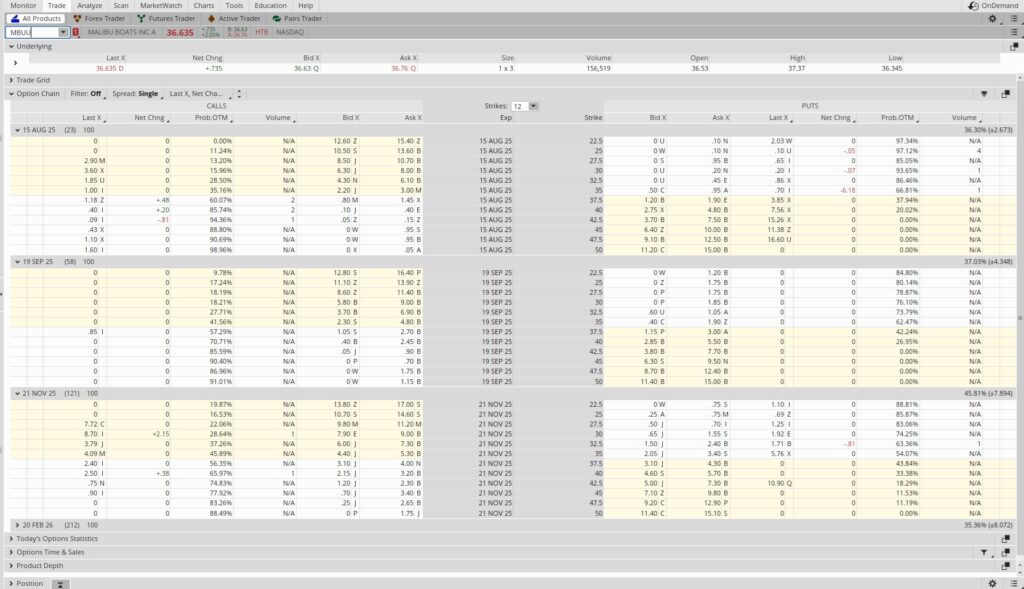
We sold to open covered call at the $37.50 strike for $1.18 and one at the $40 strike for $0.40. We split these up because there is a line of resistance around $37.40 and another resistance line around $39.00. If MBUU runs up through our $37.50 strike we’re ok with selling some shares there. Something to consider when we learn stock trading is to generate passive income selling option premium. We’ll do that on both sides of the trade. In this case we sold a covered call above the money and a cash secured put option below.
Weekly Trade Recap
We sold to open two contracts of the $32.50 put option for the 8/15 expiration date. We brought in $0.85 per share in option premium for each of those contracts. Then we sold to open one covered call option at the $37.50 strike for $1.18 in option premium. We also sold one covered call option contract at the $40 strike for $0.40 in option premium. When we learn stock trading we’re able to use this system to consistently create passive income without selling our shares. These trades bring our basis on our 800 shares of MBUU down to $28.03 per share. With MBUU trading over $36 today, we’re feeling pretty good about our position.