Simple Stock Trading Strategy
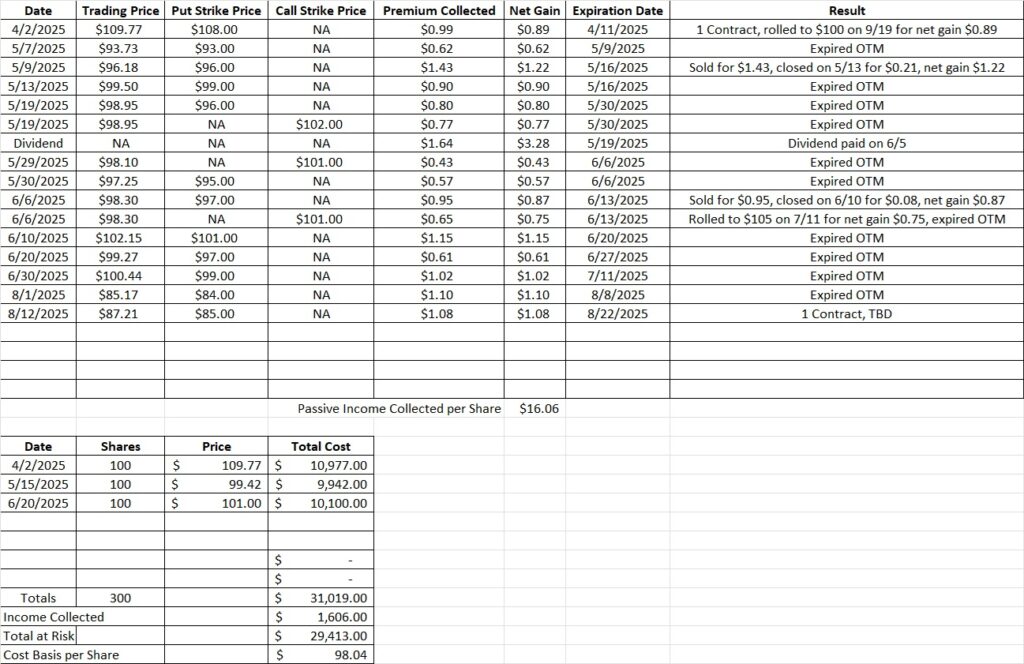
Lately our simple stock trading strategy has been doing wheel trades on UPS. We currently own 300 shares of UPS in this portfolio with a cost basis of $98.40 per share. UPS goes ex-dividend next Monday, 8/18, and the dividend amount is $1.64 per share. Our 300 shares will bring in $492 in passive income with the dividend. Now we’re going to sell another cash secured put option contract to generate more passive income.
We currently have the $100 put option for the 9/19 expiration date, and that contract is in the money. So as of 9/19 we’ll be buying another 100 shares of UPS at $100 unless we roll the position. We have room for about $60,000 worth of UPS in this portfolio, and that gives us room for two more tranches. Now we’re going to sell another put option to create some cash flow and reduce our basis.
With UPS trading just above $87 today we’re going to sell a put option just below the trading price. This simple stock trading strategy will use options premium to create passive income and reduce the basis of the shares we own. If the trading price of UPS drops we’ll have the choice of either taking the shares or rolling the position to a lower strike price at another expiration date. Our objective with this trade is to bring in option income to reduce our basis. If our contract goes in the money and we are assigned, we’ll sell a covered call on those shares. That way we’ll make money from the premium even though we buy and sell the shares at the same price.
Now let’s look at the strike price. With UPS trading at $87.20 right now we want to be close to the money, but not right at it. We’re going to look at strikes for the 8/15 expiration date and the 8/22 expiration date. UPS is up about a dollar today, which is a little over 1%. When there’s a move like that we’d prefer to not be right next to it. So we’re going to look at the $86 strike and further away. This simple stock trading strategy should give us a decent return for making the promise to buy shares of the company we want to buy, at the price we want to buy it. In this case, that’s $86 or less.
We can see the $86 strike for this Friday’s expiration date going for $0.33. Today is Tuesday, and Friday is three days from now. When we get into tighter timeframes like this we like to use one week as our time multiplier. There are fifty-two weeks in a year, so our time multiplier is 52. Then we divide the option premium of $0.33 into the $86 strike price and we get 0.0038. We multiply that by our time multiplier of 52 and we get 0.1995. That’s a 20% annualized return on the capital we’re risking on this trade. That’s decent, but we may be able to do better. If we go down to the $85 strike we’re further away from the money so the premium will be less. So let’s look at the next expiration date.
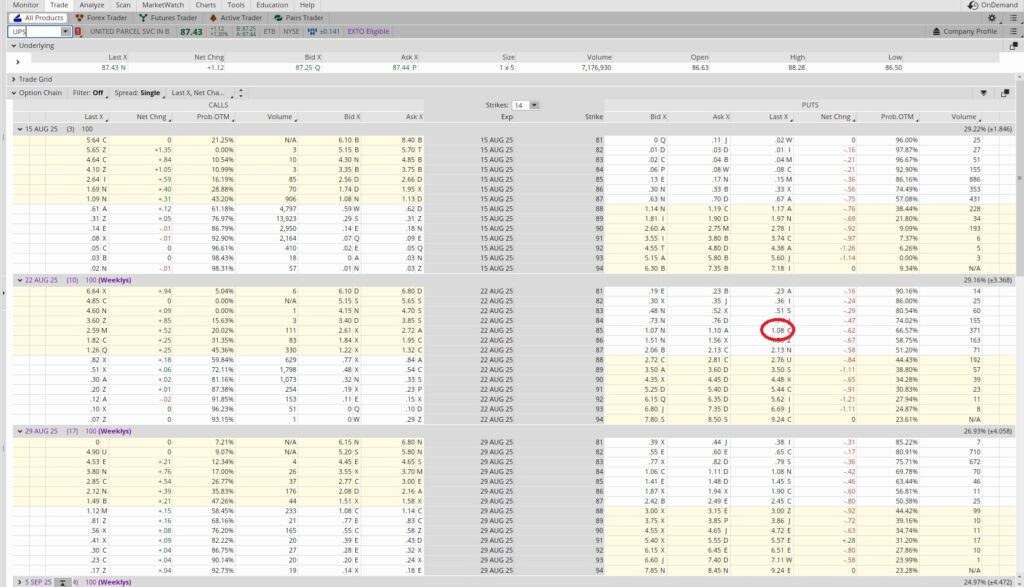
The 8/22 expiration date is ten days away. There are 365 days in a year, so our time multiplier is 36.5. The $86 put option is trading at $1.58. We divide the $1.58 in option premium by the $86 strike price and we get 0.018. Then we multiply that by our 36.5 time multiplier and we get 0.67. That’s an annualized return of 67%. That’s pretty high, and a higher return means more risk. So let’s look at the next strike down. The $85 put option for that expiration date is trading at $1.08. So we divide that option premium into the $85 strike price and we get 0.127. Then we multiply that by our 36.5 time multiplier and we get 0.464. That’s a 46.4% annualized return. Here is the option contract annualized return calculator tool we use to do that math. We’ll take the 46% on the $85 strike.
Weekly Trade Recap
We sold to open the $85 put option for the 8/22 expiration date. We brought in $1.08 in option premium on that contract. That $1.08 per share reduces our basis on the shares we own. If the trading price of UPS drops and is trading below $85 at expiration we’ll have the obligation to buy the shares at $85. We could also adjust the position to avoid assignment. If we are assigned the shares we’ll sell a covered call on those shares to create passive income. This simple stock trading strategy helps us create cash flow and reduce our basis on shares we own. Add in the dividend and we’re getting a solid return while we wait for UPS to regain it’s previous trading range. That works our basis down to $98.04 per share with the dividend upcoming. Here is the template we use to track our basis.