Cash Flow with Options
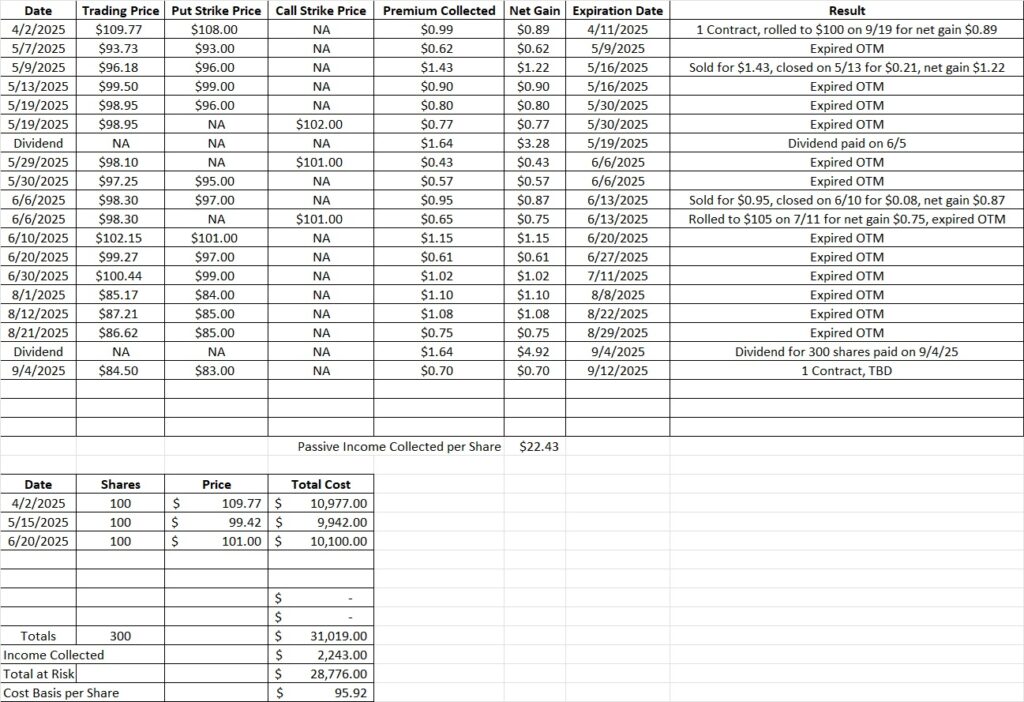
Today we’re doing a quick trade to create cash flow with options contracts. We currently own 300 shares of UPS in this portfolio. We will have another 100 shares assigned at the $100 strike price on 9/19 unless we roll the position. Today UPS is trading around $84 so we’re going to sell to open a put option contract. Here’s is our most recent post on our trades of UPS. We’re only selling to open this put option because we’re happy to buy more shares of UPS in this price range.
We currently own 300 shares of UPS in this portfolio and we just collected the $1.64 dividend on each share. That brought our basis down to $96.15 per share, and our total allocation to UPS is now $28,845. We’re comfortable with an allocation of $60,000 to UPS in this portfolio, so we have room for three more tranches. Now we’re going to sell to open a put option with a strike just below the money. We’re doing this to create cash flow with options. The closer our strike is to the trading price the more premium we’ll get when we sell to open the contract.
Today UPS is trading at $84.50. We can sell to open a put option at the $83 strike price for the 9/12 expiration date for $0.70. When we sell to open a put option we’re making a promise to buy 100 shares of the underlying company at the strike price. We need to have enough capital available in our trading account to cover 100 shares. Using the $83 strike price, we’ll need $8,300 available in our account for each put option we sell. We’re also tying up that capital for duration of the contract. We want to create cash flow with options that will give an acceptable rate of return on our capital. That means using the duration of the contract and the income from the contract to determine our rate of return.
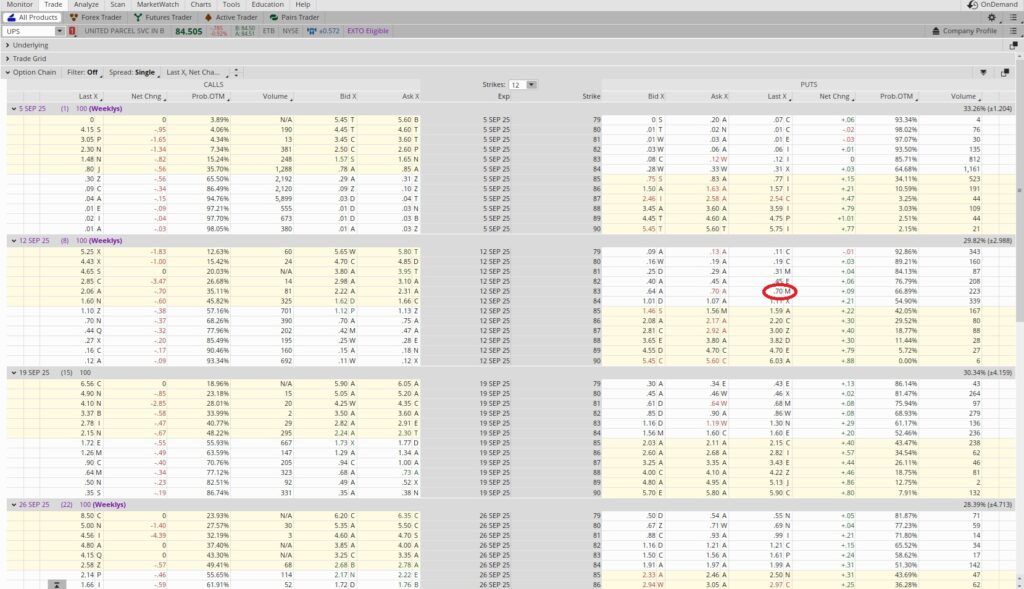
Today is 9/4 and the contract expires next Friday, 9/12, which is eight days away. There are 365 days in a year, so we divide that by the eight days the contract is active. That gives us 45. That means we could theoretically create cash flow with options using a trade like this 45 times in a year. We could do that on this company, or a similar trade on another company. That 45 becomes our time multiplier.
Then we look at the capital we’re risking and compare that with the option premium we receive for entering into the contract. In this case our strike price is $83. We’re bringing in $0.70 when we sell to open the contract to create cash flow with options. So we divide the $0.70 in option premium by the $83 strike price and we get 0.0084. Then we multiply that by the number of times we could do a trade like this in a year. That’s 45 times 0.0084. And that gives us 0.379. That’s a return of 38% when we annualize it. Here’s the option calculator tool we use to do that. Remember that we’re only selling to open this put option contract because we’re happy to add another tranche of shares at the $83 strike price. If we didn’t want more shares we would not be doing this trade.
If the trading price of UPS drops through our strike we’ll be assigned the shares at $83 at expiration. We’ll have the choice of rolling the position to different strike price and expiration date, or taking the shares. If we take the share we can then sell a covered call at our assignment strike. Then we could create cash flow with options getting into the position and on our exit. Since we already have 300 shares of UPS in this portfolio and we’re likely to get another 100 shares on 9/19, we’ll be comfortable selling a call on these shares if we are assigned.
Weekly Trade Recap
We currently own 300 shares of UPS in this portfolio and we’ve worked our basis down to $96.15 per share. We sold to open a cash secured put option contract for the 9/12 expiration date at the $83 strike price. That trade brought in $0.70 in option premium. The $0.70 per share on the contract reduces our overall basis on UPS to $95.92 per share. Here is the template we use for tracking our cost basis after we create cash flow with options.