Proven Strategy for an Individual Investor
We follow a proven strategy for an individual investor, and today we’re going to walk through it with you. We came across BLDR in early June from our research on the quarterly 13F filings. Here is our post that walks through how we do that research. We purchased 100 shares of BLDR outright back on 6/3 at $107.99 per share. We also sold to open a cash secured put option at the $105 strike for the 6/20 expiration date. That put option expired out of the money and we kept the option premium as passive income. We’ve continued selling puts at a strike that is just below the money through the summer. Each of those cash secured put option contracts has expired worthless out of the money. We’ve kept the premium from each of those put option contracts and we’ve worked our basis from $107.99 down to $87.04 per share.
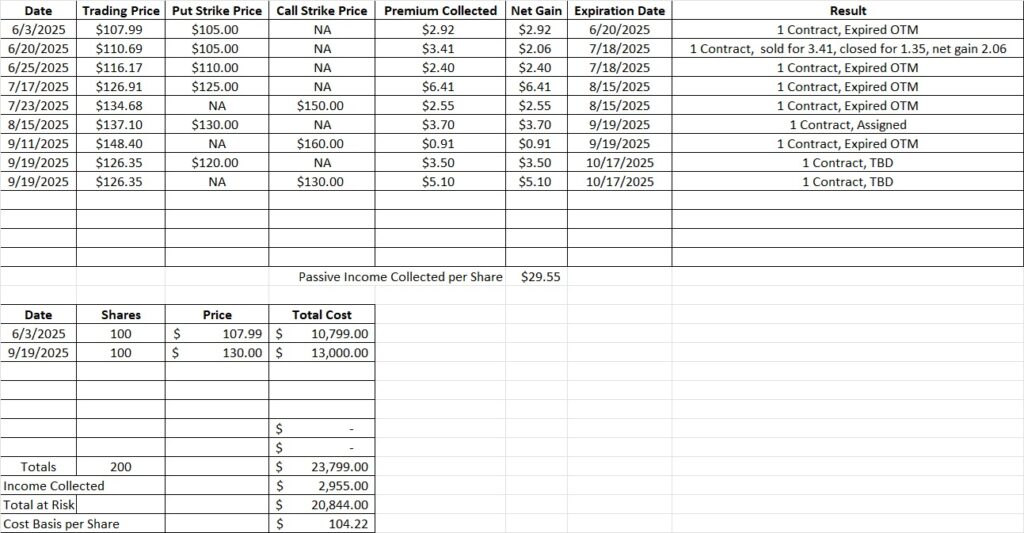
When we sell a put option we’re making a promise to buy shares of the company at our put strike. If the trading price stays above our put strike the option contract will expire out of the money. This proven strategy for an individual investor When that happens we keep the option premium we collected when we sold to open the contract. Each time we sell to open a put option we collect option premium, and we track that on this cost basis tracking template. First we track the number of shares we purchased at what price. We also track the passive income we generate from selling both cash secured put options and covered calls.
We currently have the $130 and the $160 covered call option for the 9/19 expiration date.
With BLDR trading at $126.35 today the $160 covered call will expire worthless out of the money. The cash secured put option at the $130 strike is in the money. Let’s discuss keeping that contract and taking the shares or rolling it to a lower strike price. We currently have 100 shares of BLDR with a basis of $87.04 per share. That’s a great position to be in, and with BLDR trading at $126 we’re already profitable on this company. Here is our most recent post of our trades on BLDR, and also the prior post from 6/3.
We like the prospects for BLDR, and we’d like to have another tranche of shares so we can continue trading the company as it runs up. So choice number one is to take the shares. If we do that we can sell a covered call at the $130 assignment strike. Since we sold to open the $130 put option for $3.70 in option premium our basis on those shares is actually $130 – $3.70, or $126.30. So if we sell the $130 covered call for the $5.10 it’s trading at right now it will drop our basis on that tranche from $126.30 down to $121.20. If we’re called away at $130 we’ll have a return of $8.80 on our $130 investment over the course of two months. This proven strategy for an individual investor would give us a 40% annualized return, and we’d be happy with that.
Another choice is to buy to close the $130 put option, then sell to open another put to make up for the cost of closing our current trade. We sold to open the contract for $3.70, and right now we can close it for $3.58. That would net us a gain of $0.12 for the past month on that capital. Not great, but not a loss. Then we could sell the October $120 put for $3.50. That would put us in a position to buy another 100 shares at an effective purchase price of $116.38 ($120 – $3.50 in premium – the $0.12 we net from closing the current trade). That would mean if BLDR stays above $120 through 10/17 we would only have our original 100 shares.
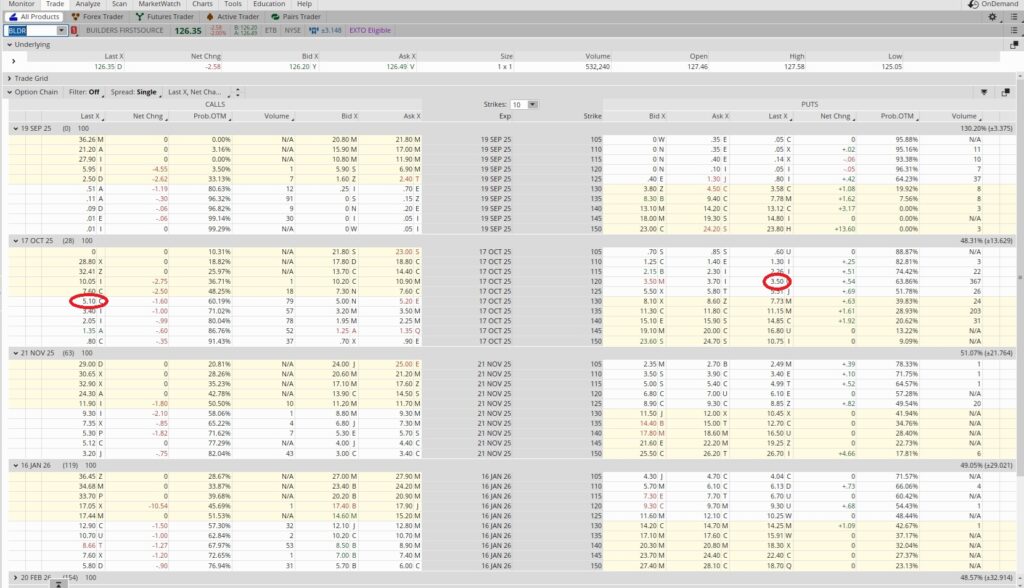
Since we only have one tranche of BLDR right now we’re going to take the shares on our put at the $130 strike. We sold to open the $130 call for the 10/17 expiration date for $5.10 per share. We also sold to open the $120 cash secured put option for the 10/17 expiration date. The put is our promise to buy another 100 shares of BLDR at $120 per share on or before 10/17. We brought in $3.50 per share in passive income when we sold to open that contract.
We want to be sure we’re generating an acceptable return on our capital for the duration of the contract. Here’s how we determine that. Since it’s a one month trade we could do a trade like that 12 times over one year. So our time multiplier is 12. Then we divide the $3.50 in premium by the $120 strike price and we get 0.29. We multiply that by our time multiplier of 12 and we get 0.349. That’s an annualized return of 34.9%. We typically target an annualized return of 20% or greater when we well to open a put option. This proven strategy for an individual investor checks that box. Here’s the option return calculator tool we use.
Weekly Option Trade Recap
We’re taking the shares at the $130 strike on our put option that expires today. That gives us 200 shares of BLDR. Then we sold to open the $130 covered call on those shares for $5.10 in option premium. We also sold to open the $120 put option for the 10/17 expiration date for $3.50 in premium. This nets out to a total of 200 shares of BLDR with a cost basis of $104.22 per share. With BLDR trading at $126 right now this proven strategy for an individual investor has put us in a profitable position. Here’s the template we use to track our cost basis per share with our trade history.