Adjust the Option Position
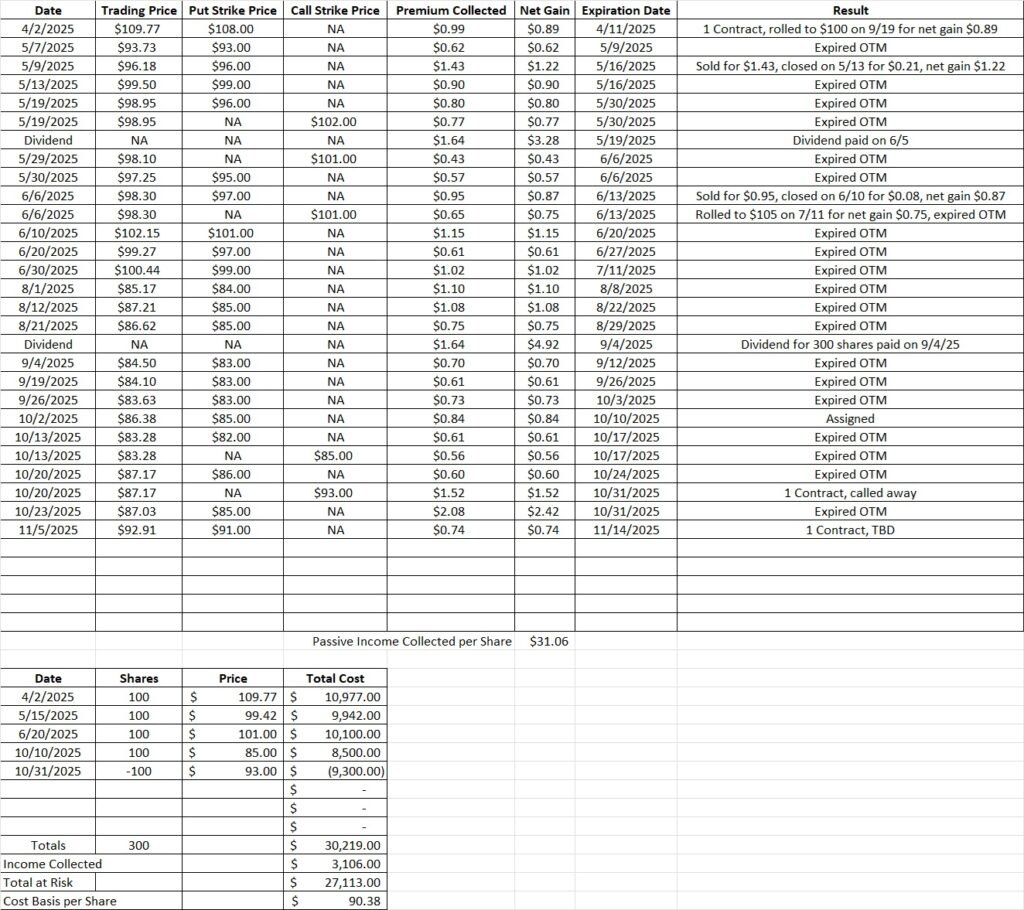
Today we’re going to walk through how we decide if we will adjust the option position or let shares go. We’ve been trading UPS and we currently have 300 shares in this portfolio. We’ve worked our cost basis down to $90.62 per share, and we own 300 shares in this portfolio. We started by selling puts on UPS with strike prices that were just below the trading price. We did that a few times before we were assigned shares, and we kept the option premium each time. Once we had a few hundred shares we continued to sell cash secured puts with strike prices just below the trading price. We then also sold covered calls on some of our shares with strike prices just above the trading price. We’ve been repeating this process a few times each month, collecting option premium as passive income with each contract we sell.
Some of our recent weekly options trades for cash flow on UPS are here, here, and here. This link gets into our strategy of selling options for income in more detail. Last week we had a covered call at the $93 strike. We also had a cash secured put option at the $85 strike. UPS did well on their earnings call and shot up above our call strike. We had the choice to adjust the option position to keep the shares or let the shares go. Since we had purchased that tranche of shares at the $85 strike we decided to let the shares go and lock in a profit of $6 per share on the sale. Now we can be aggressive in selling a cash secured put option at a strike near the trading price.
UPS pays a healthy dividend, and the stock goes ex-dividend on Monday, 11/17. Ex-dividend means that 11/17 is the first day that UPS will trade without the shareholder getting the dividend for the prior quarter. So if we want the dividend, we need to own shares prior to 11/17. The dividend for UPS is currently $1.64 per share. That means we’ll receive $164 for every 100 shares of UPS we own. Our basis on UPS is currently $90.62 per share, and with the dividend we’ll bring that down to $88.98 per share. On our 300 shares that brings our total cash allocation to UPS to $26,694. We have room for $60,000 of UPS in this portfolio, so now we’re going to be a little more aggressive with our cash secured put options. If the trading price of UPS drops significantly we can always adjust the option position.
Today is 11/5 and UPS is trading at $92.91 per share. We’re going to sell to open the $91 put option for the 11/14 expiration date. When we sell to open a put option we’re making a promise to buy shares at the strike price on or before the expiration date. Each contract is for 100 shares, so for one contract we need to have 100 x the strike price available in our brokerage account. In this case, that’s $9,100. Since we won’t have access to that capital until the contract expires or we adjust the option position, we want to be sure we’re our capital will generate an acceptable level of return. We’d like to get at least a 20% annualized return on our capital. We take a few steps to evaluate our annualized return and compare different option strike prices before we select one.
The first thing we’ll do is look to see when we want our contract to expire. In this case we’d like a shorter term contract, so we’re aiming for the 11/14 expiration date. That’s nine days from now. There are 365 days in one year, so we divide 365 by 9 and we get 40. In theory we could do a trade like this 40 times over the course of a year. That’s our time multiplier.
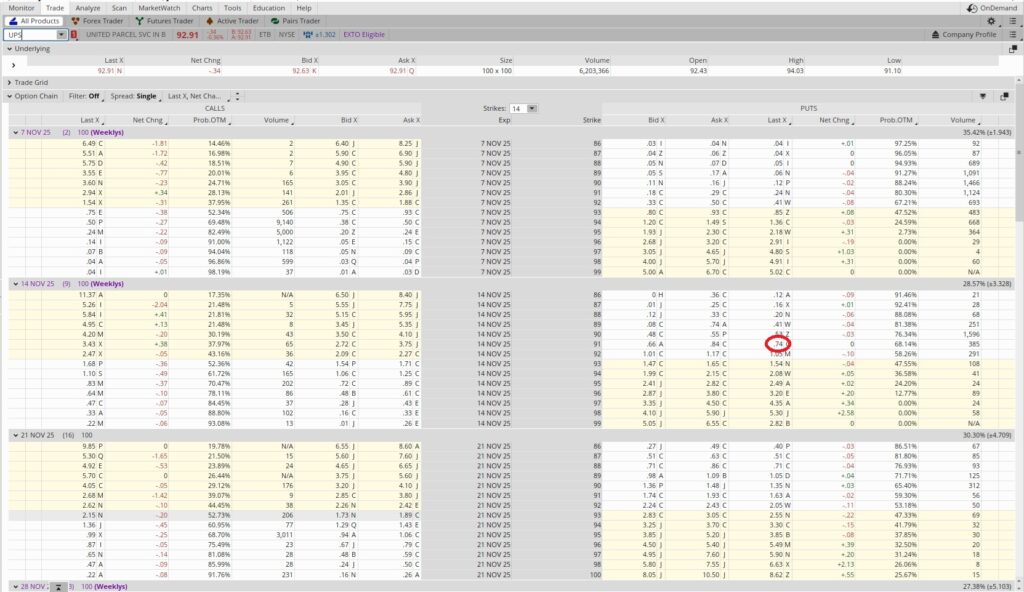
Now we’ll look at the capital portion. The $91 strike is going for $0.74 per share. So we need to put up $91 per share to make $0.74 per share for the nine days this contract is active. And it’s possible we could have to buy the shares or adjust the option position. So we divide the $0.74 in premium by the $91 strike and we get 0.0081. Then we multiply that by our time multiplier of 40 and we get 0.325. That’s an annualized return of 32% for making a promise to buy shares of a company we want to buy, at the price we want to buy it. We like that, so we’re going to sell to open that contract. Here’s the option contract return calculator we like to use.
Weekly Option Trade Recap
We sold to open the $91 put option for the 11/14 expiration date on UPS for $0.74. That trade gives us an annualized return of $32% and brings out basis on UPS down to $90.38 per share. Here’s a link to the template we use to track our trade history and cost basis.