Beginner Options Trading Strategy
Today we’re going to walk through a profitable beginner options trading strategy. We like to trade options for cash flow to enhance our return. This is part of our long term investing strategy in the stock market. Short term traders can also use this strategy. We find a company we like and want to hold for the long term. We can buy or sell shares outright, or we can use derivatives to create cash flow while we acquire and hold shares. Then we can also use derivatives to close out of our position. Here’s how that trading plan works.
We identify a company we like that is trading near a price range we’d like to buy it. We use the 13F filings to help with that. The investment managers who run larger funds need to disclose what their fund bought an sold each quarter. That disclosure is on the 13F filing, and those are public record, so we can benchmark those companies. When we see a company that several fund managers are buying at the same time, that company becomes a starting point for further research. Here’s more detail on the 13F process.
Once we find a company we like that’s trading near a price we want to buy it we can start to use that company to crease weekly or monthly cash flow. We’ll sell a put option contract with a strike price just below the current trading price. We’ll collect option premium when we enter the contract. The premium we collect when we sell to open the contract is ours to keep regardless of how the contract plays out.
For example, a company is trading at $35 per share. We sell to open a put option at the $34 strike price and we collect option premium from the buyer of the contract. When we sell to open that put option contract we’re making a promise to buy shares of that company at that $34 strike price. If the trading price stays above our $34 strike price through the expiration date the put option contract will expire out of the money worthless. If the trading price movements drop below our $34 strike price on or before the date the contract expires we’ll have the obligation to buy the shares at the strike price. We definitely will be assigned shares if the trading price is below our strike at expiration.
When we sell to open that cash secured put option contract we’re making a promise to buy shares of the company at the strike price. Each option contract represents 100 shares of the company’s stock or the index fund. That means we need to have enough capital in our brokerage account to cover the cost of buying 100 shares of the company or index fund when we sell to open the put option contract. If we sell to open a put at the $34 strike price, we’ll need $3,400 to back that up in our account. And we’ll need that for each put option contract we sell. That capital will be locked up until the contract expiration date.
Depending on the trading volume of the company or index there may be monthly or weekly option contracts available. A company with lower trading volume will have option contracts that expire on the third Friday of the month. A company with higher trading volume may also have weekly option contracts available. Weekly contracts have expiration dates every week on Fridays.
So we sell to open a put option contract, and that contract obligates us to buy 100 shares of the company at $34 per share. We collect the option premium, and if the trading price stays above our $34 strike price the contract will expire out of the money worthless. Then the next week (or month) we do that again. Since we’re locking up our capital for the duration of the contract we want to be sure we’re getting an acceptable level of return on our capital. We know we can get an interest rate of 3 to 4% just letting our funds sit in our brokerage account, so we need a higher return to lock up our capital for a period of a week or a month.
We like to target an annualized return of at least 20% when we sell to open a put option contract.
There are two things we look at on the trade to determine that annualized return. The first is the duration of the contract, or the number of days the contract will be active. The other is the amount of money we’ll bring in with the option premium compared with the amount of capital we need to put up for the trade. On a one month long trade we know there are twelve months in a year. That makes our time multiplier twelve. On a one week long trade our time multiplier would be 52 because there are 52 weeks in a year. Then we look at the capital required vs the passive income we generate with the option premium.
Let’s say we can sell to open the $34 put option for $0.30 per share. We divide the $0.30 in option premium into the $34 strike price and we get 0.0088. Then we multiply that by our time period. If this trade had a duration of one week we would use a time multiplier of 52. So 52 times 0.0088 is 0.458. That gives us an annualized return of 45.8%. That’s a solid level of return on our capital for the duration of the contract. It’s significantly more than the interest rate we would receive having the capital just sitting in our trading account. It’s also much more than we would receive on a bond. And it’s also more than the 20% annualized return we would target. So that would be a solid trade, provided we are comfortable buying shares of the company at $34 each.
Now let’s say this is a one month long trade, and the option premium is still just $0.30 per share. As a one month long trade we could do this trade only twelve times over the course of a year. So we multiply that 0.0088 by 12 and we get 0.106. That’s an annualized return of 10.6%. That’s not enough to compensate us for locking up our capital for the duration of the trade, so we would pass on that one. Here’s an option contract return calculator that makes this easier.
Let’s circle back to our strategy. We have a company we like and it’s near our buy price. We sell to open a put option contract, collect some option premium, and wait for the contract to expire. If the trading price stays where it is or goes up, we keep the premium, the contract expires out of the money, and we sell to open another put option contract. If the trading price drops through our strike we keep the premium and take the shares. Either way we keep the option premium. Then we sell to open a covered call option contract on the shares we were just assigned. We sell that at the strike price we bought the shares. We also sell to open another put option contract with a strike price that’s a little further down. Now we’re collecting option premium on both sides of the trading price. The premium on the puts are below the trading price and premium from a covered call is above the trading price. This beginner options trading strategy is called a wheel trade, and here’s a more detailed explanation.
Wheel Trade Example
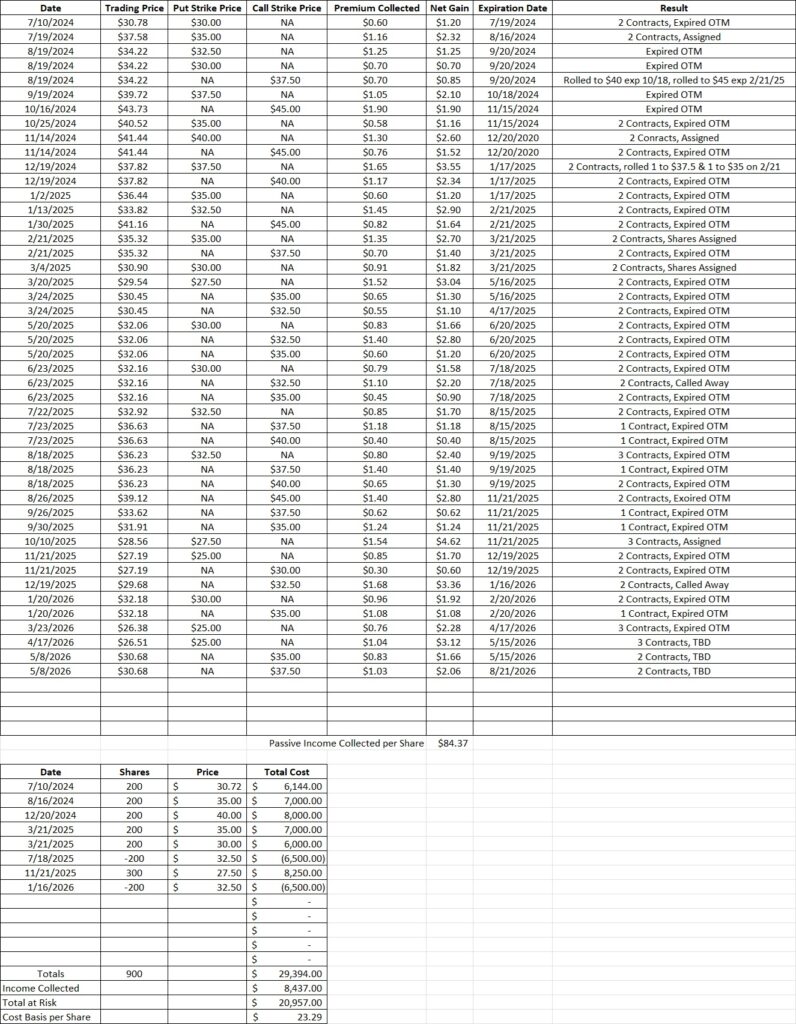
Here’s an example of how this works in practice. We currently hold 900 shares of MBUU in this portfolio with a basis of $23.70 per share. We have three contracts of the $25 put option for the 5/15 expiration date. Each of those contracts brought in $1.04 in option premium, for a total of $312 in passive income. Today MBUU is popping up because of their double beat on their earnings call yesterday. With our basis of $23.70 per share and MBUU trading over $30 per share right now, we’re in a profitable position. We’d like to hold some shares for the long run, but we also want to use our shares to create some cash flow. Now we’ll use covered called to generate passive income and fit within our risk tolerance.
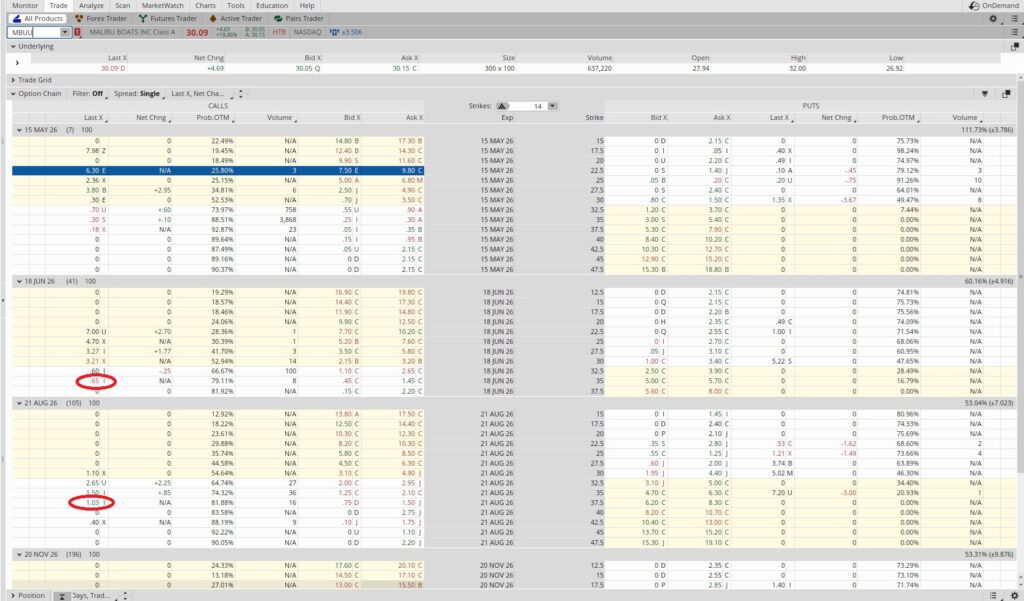
So we sold to open two covered call contracts at each of two different strikes. We sold to open the $35 call for the 6/15 expiration date. That simple options trade gave us $0.65 per share in option premium, or $130 total. We also sold to open two call option contracts at the $37.50 strike for the 8/21 expiration date for $1.03 each. That trade gave us $300. So these two easy options trades gave us $336 in passive income. And we can use that to reduce our basis. As long as the trading price stays below $35 we’ll capture the time decay and the options expire out of the money worthless. If the trading price rises and we have shares call away at $35 we’ll still hold 700 shares. If MBUU rises up through our $37.50 strike and we’re called away, we’ll still hold 500 shares and our new basis will be just $12.91 per share. As it stands right now, our basis is $23.29 per share. Here’s the template we use for tracking our basis.