Buy Shares of Stock Using Options
Today we’re going to walk through how we buy shares of stock using options. The first step is to identify a company we want to own and do the valuation on it. A main focus is to have a company that we’re able to understand and that we feel is interesting enough that we’ll pay attention to it for the next year or two. Here’s a post that walks through how we find meaning in a company.
We want the company to have a long term competitive advantage. In investing parlance, this is known as a ‘Moat’. Here’s a post that walks through the different types of moats. We also want the company to have a strong, stable management team that puts the owners of the company first. Then we look at what caused the share price of the company to drop to a price we’re comfortable buying shares. We want to understand what caused the drop and be sure the company is in a position to not only withstand the storm, but come out stronger on the other side in a year or two. Here’s a posting that walks through how we evaluate events like that.
Before we buy shares of stock using options we want to be sure there are experts who are buying shares. If we can find expert investors who also like the company it gives us a higher comfort level before we invest our own capital. We follow the 13F filings of a few hedge fund managers to benchmark our holdings. Here’s an article that walks through how we follow the expert fund managers. Here’s the tool we use to do that research.
We have a company we like and we’re comfortable with the trading price. Some of the expert fund managers we follow are buying shares, we’ve done our inversions on the event, and we’re ready to buy shares of the stock using options. After their most recent earnings call we purchased 100 shares of CROX at $82.66. We’ve been using put options to create cash flow for us as we’ve been positioning ourselves to buy more shares. In this portfolio we’re comfortable allocating about $60,000 to one company. We break that up into tranches. With CROX trading in the mid $80’s right now we can get about seven or eight tranches for our $60,000. We’ve been using cash secured put options to get paid to create passive income as we establish our position.
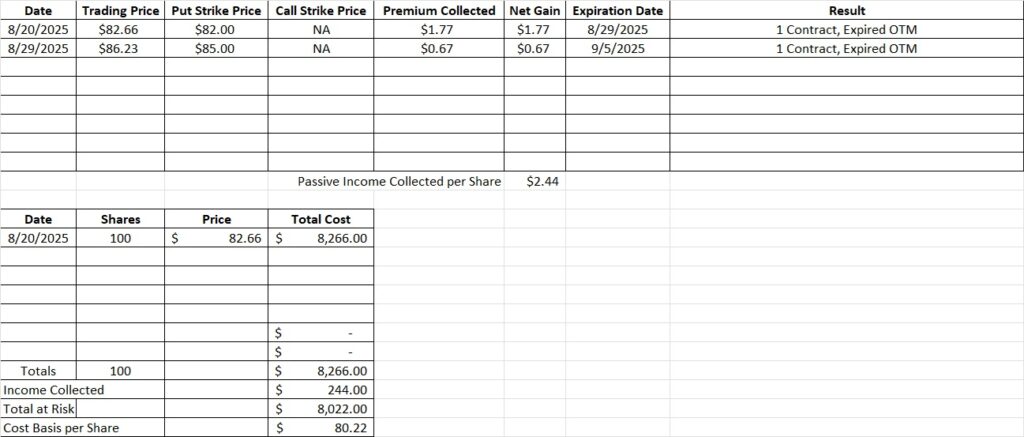
We purchased 100 shares of CROX on 8/20 at $82.66 per share. Then we sold to open one contract of the $82 put option for the 8/29 expiration date. We brought in $1.77 in passive income when we sold to open that option contract. CROX continued trading above our $82 strike price and our contract expired out of the money. So we kept the premium, and on 8/29 we sold to open another put option, this time at the $85 strike. That contract gave us $0.67 in option premium and expired out of the money on Friday, 9/5. The options premium from both of those contracts reduced our basis per share from $82.66 down to $80.22. And we still own those 100 shares.
The table below shows our trade history. Our purchase of CROX shares on 8/20 is near the bottom of the table. Above that we can see the two put option contracts we sold to open and premium for each contract. When we promise to buy shares of stock using options we create equity in the shares we own. Here is the cost basis tracking template we use.
When we sell to open a put option we’re making a promise to buy shares of the company at the strike price. We pick the strike price, and we need that strike price to be an amount we’re comfortable paying for shares of the company. If we promise to buy shares at a certain price and the trading price drops below that price, we’re still obligated to buy shares at the price we promised. So we need to be comfortable buying shares at the strike price.
We bring in option premium as passive income when we make the promise to buy shares of stock in the company. We get to keep that option premium regardless of what happens with our put option contract. If the trading price stays above our strike and the contract expires out of the money, we get to keep the premium. If the trading price drops, the contract goes in the money and we buy shares at the strike price, we still get to keep the option premium.
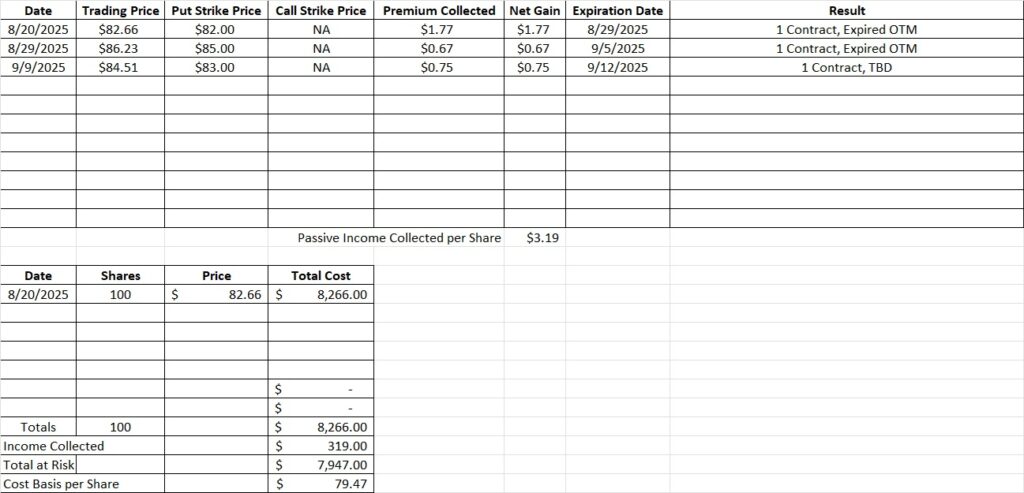
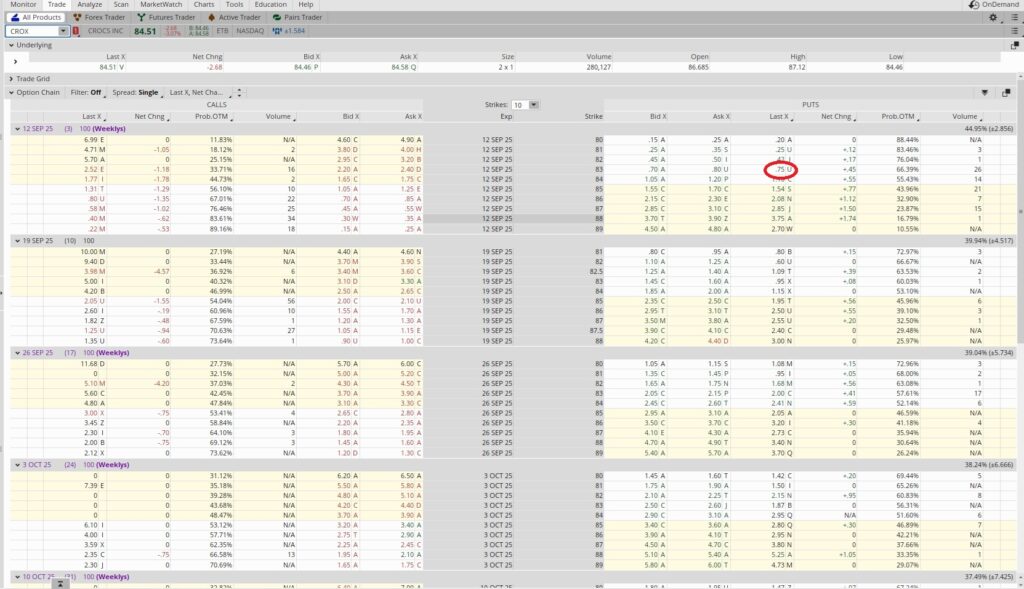
Now we’re going to sell to open another cash secured put option. We sold the $83 cash secured put option contract for the 9/12 expiration date for $0.75 in option premium. When we sell to open a put option contract we need to have enough capital in our brokerage account to cover the cost of the shares we’re promising to buy. One option contract represents 100 shares. So we need 100 times the strike price, or $8,300, available in our account to make this trade. We’re locking up that capital for the duration of the trade. This trade goes through this Friday, 9/12, so we could say this trade is active for one week. Since our capital is tied up for awhile, we want to be sure it’s generating an acceptable level of return.
We use two factors to determine our return, the capital we’re risking and the time period we’re risking it. We’re receiving $0.75 per share in option premium and risking the $83 strike per share. So we divide $0.75 into $83 and we get 0.009. This trade lasts for one week. We could theoretically do this trade (or a similar trade on a different company), 52 times in one year. That means our time multiplier is 52. Then we multiply that 0.009 by 52 and we get 0.469. That’s an annualized return of 46.9%. We’re only selling to open this put option because we’re happy to buy shares of CROX at the $83 strike price. Here’s the option contract return calculator we use.
Option Trade Recap
We currently own 100 shares of CROX in this portfolio. We sold to open a put option at the $83 strike for the 9/12 expiration date. That trade gave us $0.75 per share in option premium. Our basis on CROX is now down to $79.47 per share. That put is a promise to buy shares of stock using options.