Make Some Quick Cash Trading Options
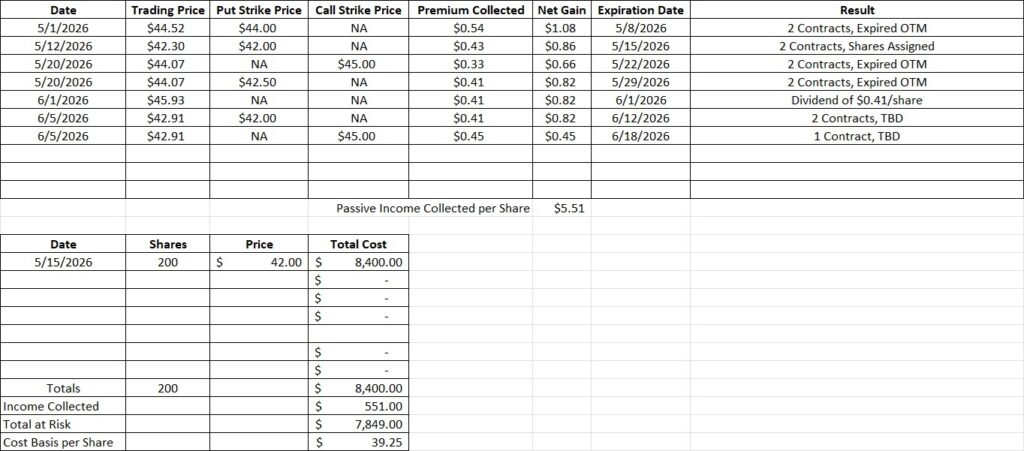
Today we’re going to make some quick cash trading options. We currently hold 200 shares of NKE in this portfolio. We sold to open the $44 put option for the 5/8 expiration date and brought in $0.54 per share in option premium. The time decay went our way and that trade expired out of the money. Then we sold to open two contracts of a put option at the $42 strike price for the 5/15 expiration date. We collected $0.41 per share in option premium on that trade. When that contract expired NKE was trading at $41.88, so we took the shares. Here’s our post that walks through that options trade. NKE went ex-dividend on 6/1, and that passive income will be credited to our account on 7/1. Our current basis on our position is $39.88 per share.
With NKE trading at $42.91 today we’re in a profitable position right now. Let’s talk through our long term investing strategy using these weekly options trades for consistent monthly cash flow.
When we buy or sell shares of stock we prefer to use derivatives to help us with our position. The derivatives are called ‘stock options’, and there are two types: put options and call options. When we sell to open a put option we’re making a promise to buy shares of a company at the strike price. We choose the company, we choose the strike price, and we also choose the expiration date of the option contract. We even choose the amount of option premium we receive. If we don’t like the amount of option premium, then we don’t enter the trade. Here’s more detail on how a put option works.
Two things can happen when we sell a put option. The first is that the trading price of the company can drop below our strike price. If that happens we’ll have the obligation to buy 100 shares of the company at the strike price for each contract we sold. That means we need to have enough capital in our trading account to pay for 100 shares of the company at that strike price. So if we sell a put at the $40 strike, we need to have at least $4,000 available in our account to cover that trade for the duration of the contract. The other potential outcome is the trading price stays above our strike price and the option contract expires out of the money. We keep the option premium regardless of what happens with the contract.
There’s a chance the price movement of the company moves the trading price below our put option strike price, and if that happens we’ll be assigned shares at our strike price at expiration. We need to be ok with purchasing shares of the company at the strike price when we sell to open a put option contract. That means we should only sell a put option contract on a company we want to own, and only at a strike price that we’re comfortable with paying for shares of the company. This options trading strategy works with companies and also index funds. We can use this profitable stock trading strategy to consistently make some quick cash trading options.
So we sell to open an option contract and that contract may expire out of the money. If that happens we’ll have access to our capital again at expiration. Then we can sell another put option. We’ll repeat this process and collect option premium with each option trade. We’ll continue to do this until a contract goes in the money and we get shares. Once we have shares we’ll sell a covered call on some of those shares. A covered call is similar to a put, but just the opposite. It’s a promise to sell shares at a certain price, on or before a certain date. We also choose the amount of option premium we’ll accept to enter a covered call option contract. We’ll choose a strike price for the call that it at or higher than the assignment strike price of our shares.
We’ll also only sell calls on a portion of our position. The idea is that we’ll use option premium on the front end as we establish a position. By the time we’ve accumulated some shares we’ve likely built some equity in the position. Then we’ll sell covered calls to create more cash flow trading options while we own shares. And when we sell the covered calls, we won’t sell calls on our entire position. The premise is that we’ll use the option premium to create equity in our position, and when we eventually have shares called away we’ll be selling shares that have a lower basis than the price we sell them. That will further reduce our basis on the shares we still hold. If all goes according to plan, we’ll eventually hold a few shares indefinitely after we’ve recuperated all of the capital we invested in the trading plan.
When we sell to open that first put option contract we’ll be locking up our capital for the duration of the trade. There’s risk with that, we want to get better than just the average interest rate as a level of return. We look at a few factors when we choose a weekly options trade for passive income. The first is the strike price vs the option premium we’ll receive to endure the time decay. Let’s look at the option chain for NKE. We like to go out a week or two for a cash flow trade like this, so we’re looking at the 6/12 and 6/18 expiration dates.
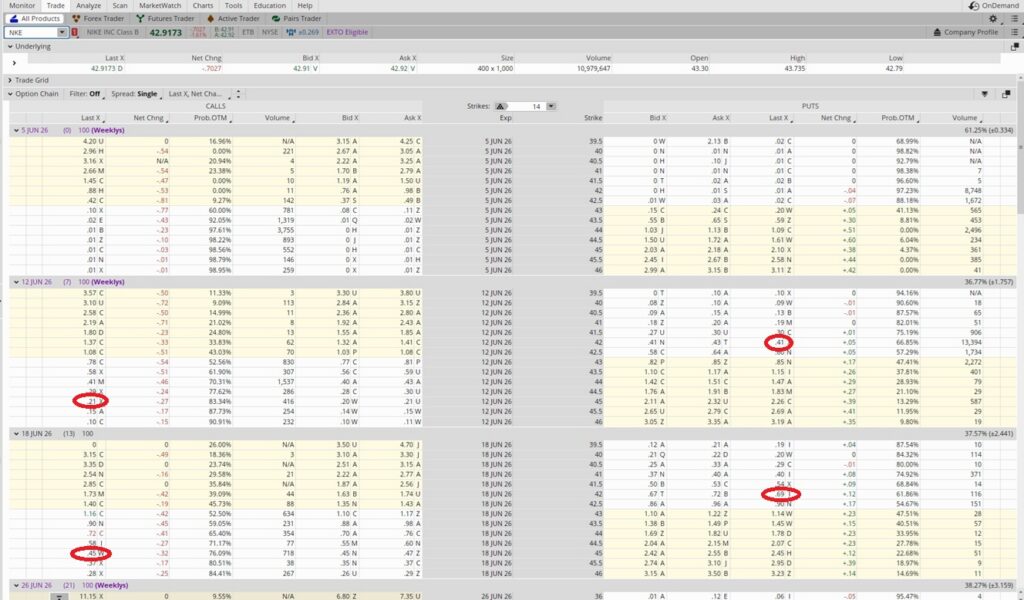
With NKE trading at $42.91 right now we can see the $42 put for the 6/12 expiration date recently traded for $0.41. We divide that $0.41 in option premium by the $42 strike price and we get 0.0098. This trade has a duration of one week, and there are 52 weeks in a year. That makes our time multiplier 52, because we could do a trade like this 52 times over the course of a year. So we multiply our 0.0098 by 52 and we get 0.508. That’s an annualized return of 50.8%. That’s solid.
Now let’s compare that with the same $42 strike on the 6/18 expiration date. That has a mark of $0.69. We divide the $0.69 in option premium by the $42 strike price and we get 0.0164. Then we multiply that by 26, because the duration of this trade is two weeks, and there are 26 periods of two weeks in one year. That gives us 0.427. That’s an annualized return of 42.7%. Would we rather make 50.8% for one week, or 42.7% for two weeks? We’ll go with the 50.8% for one week, and we’ll do two contracts. If the price movement drops below our strike price and we’re assigned at $42 we’ll double our position in NKE. If the trading price stays above our $42 strike price we’ll sell another put option next week. Here’s our option contract return calculator that helps us choose a profitable options contract.
We’ll also sell a covered call on the other side of the price range. Since we hold 200 shares we’re only going to sell one covered call. If the trading price moves up through our call strike our shares will be called away. That’s good because it will reduce our basis on the shares we continue to hold. It also means we’ll forgo any additional upward price movement on those shares. When we sell a covered call we want the call strike price to be at least as high as the assignment strike where we purchased shares. We also want to be above a resistance level on the candle chart. If we’re above a resistance level, there’s a chance that support line will slow down an upward price movement. That will give us a better chance of our call option expiring out of the money and keeping our shares.
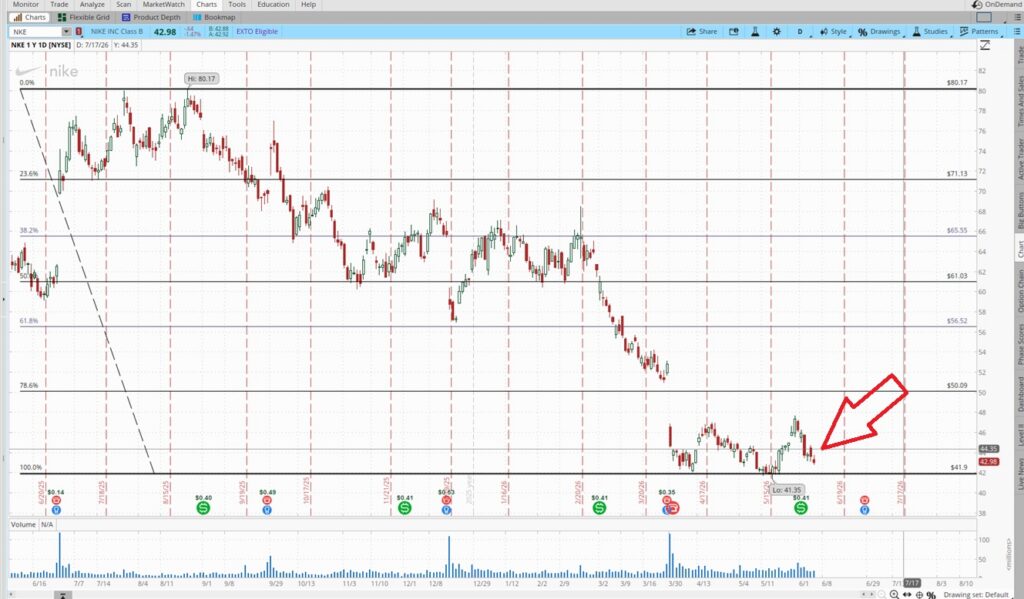
Here’s the price chart on NKE. It’s a one year chart with daily candles. We also have Fibonacci lines drawn, and we can see another level of support at $44.35. We want to be above that $44.35, so we’re looking at the $45 strike price.
On the option chain for NKE we can see the $45 call strike for 6/12 is trading at $0.21. The $45 call strike for the 6/18 expiration date is trading at $0.45. Would we rather make $0.21 for one week or $0.45 for two? We’ll go with the $0.45 for two weeks. We’re only doing one contract, not two, to be sure we still hold some shares if the price runs up.
Weekly Option Trade Recap
We sold to open two put options at the $42 strike for the 6/12 expiration date. We also sold to open one covered call at the $45 strike for the 6/18 expiration date. We’re able to make some quick cash trading options with simple trades like this. We also reduced our basis down to $39.25 per share. Here’s the template we use to track our options trade history and our cost basis on our shares.