Roll an Option Trade
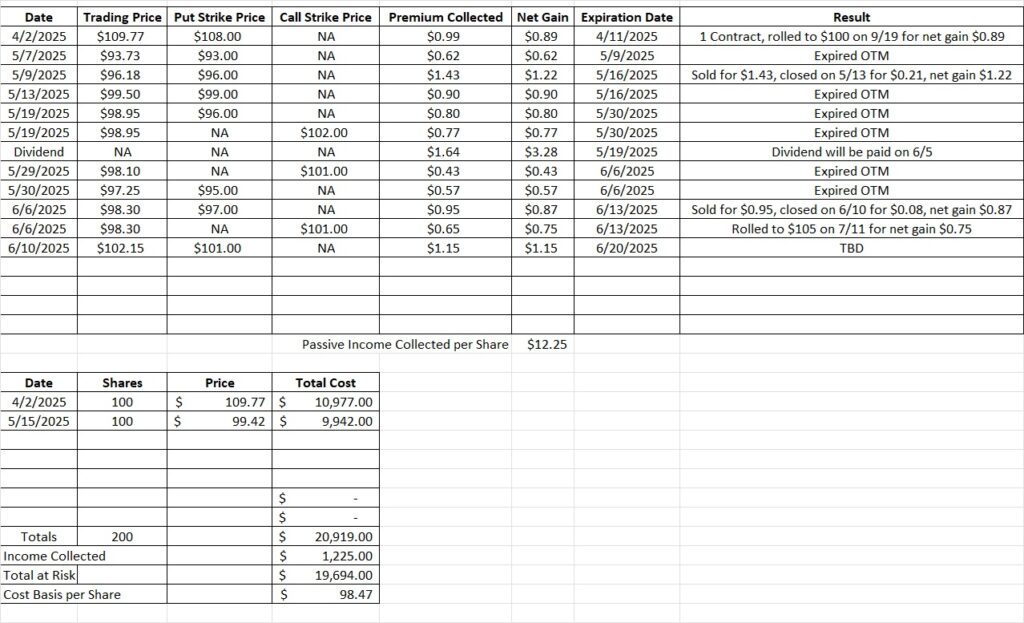
Today we’re going to walk through how to roll an option trade. We’ve been trading UPS as we establish a position in the company. We currently own 200 shares of UP in this portfolio with a basis of $99.06 per share. For us, that’s two tranches of UPS, and we have room for six. We have a cash secured put option at the $97 strike and a covered call option at the $101 strike. Each of those trades expires this Friday, 6/10. Here’s a link to the post that walks through those trades. UPS has some positive momentum right now and today is trading at $102.30. That puts us in a profitable position and we’d like to keep the shares we own right now. Ideally we’d like to get more shares before UPS runs up above our buy range.
When we roll an option trade we buy to close one contract and then sell another option contract in a more favorable position. Last Friday we sold to open the $97 put option contract for $0.95. Today we bought to close that option contract for $0.08. That gives us a profit of $0.87 on the trade. Now we’ll move that put option up to a strike that is closer to the money and more likely to get us the shares. We sold to open the $101 put option for the 6/20 expiration date for $1.15. That’s pretty close to the money, but we’re being aggressive here because we’d like to get more shares. If we don’t get more shares, at least we’ll reduce our basis a healthy amount.
When we sell to open a put option we’re making a promise to buy shares at the strike price. One contract is for 100 shares. We need to have 100 times the strike price available in our brokerage account for each put option contract we sell to open. Selling the $101 put option contract means we’re promising to buy 100 shares of UPS for a total of $10,100. We won’t have access to that capital again until the expiration date of the contract. Since we’re locking up this capital for a time period, we want to be sure we’re generating an acceptable level of return on our capital.
Let’s walk through how we determine our rate of return using this stock option annualized return calculator. Today is Tuesday, 6/10. This trade expires next Friday, 6/20. That means this trade is active for 10 days. Since we’re risking our capital for all 10 days of the trade, we’ll use that 10 day time period for our time multiple. These are 365 days in a year, so we divide 365 by the days the trade is active (10), and we get 36.5. So our time multiplier is 36.5, because we could theoretically do this trade (or a similar trade on a different company) 36.5 times over the course of one year.
Then we look at the premium vs the strike price. In this case we’re getting $1.15 in option premium for risking $101. So we divide the $1.15 into the $101 strike price and we get 0.011. Then we multiply that by our time multiplier of 36.5, and that gives us 0.416. That’s an annualized return of 41.6% on the capital we’re risking by entering into this option contract. We like to get at least a 20% annualized return when we sell to open a put option. This trade is giving us double that, so we’re happy there. Keep in mind we are only selling to open this put option because we’re happy to buy shares of UPS at $101. If we did not want to buy shares at $101, we would not be entering into this option contract.
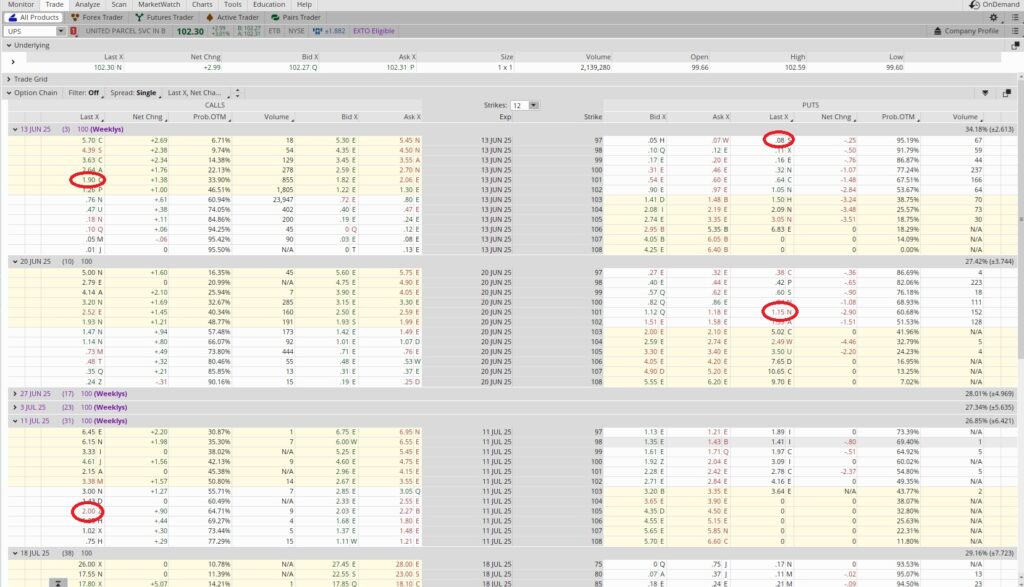
We also have the covered call option at the $101 strike for this Friday. With UPS trading at $102.30 our covered call option is in the money. That give us a choice. We can roll an option trade to hang on to the shares. Or we can let the shares go if UPS continues to trade over $101 through the expiration date this Friday. Although it’s in the money, we still have three more days of trading before the contract expires. We’d like to put ourselves in the best position we can to keep our shares. We’ll see if we can put ourselves in a better position by closing the trade and selling a new call at a higher strike.
When we sold to open the $101 covered call we brought in $0.65 in option premium. That passive income is ours to keep unless we roll an options trade. If we roll the trade, we’ll buy to close the current contract, then look for another contract at a higher strike price that is further out in time. When we buy to close the contract, we include that $0.65 in the trade. We bought to close the $101 call option for the 6/13 expiration date for $1.90. That gives us a temporary loss of $1.25 on the trade. Then we sold to open the $105 covered call for the 7/11 expiration date for $2.00 in premium. That gives us a net profit of $0.75 on the trade. It also positions us to sell 100 shares at $105 vs the $101 we had earlier.
Weekly Option Trade
We had a cash secured put option at the $97 strike and a covered call option at the $101 strike for this Friday’s expiration date. We bought to close the put for $0.08, netting us a gain of $0.87 on the trade. Then we sold to open another put at the $101 strike for the 6/20 expiration date. Then we closed our $101 covered call and sold the $105 covered call for the 7/11 expiration date. When we roll an option trade we want to put ourselves in a better position. We’d much rather sell our shares for $105 vs $101, so we’re happy with that trade. These trades bring out basis on UPS down to $98.47 per share. We’re now also in a position to buy more shares of UPS at $101 if our put option goes in the money.