Simple Options Trade for Weekly Income
Today we’re going to do a simple options trade for weekly income. We currently hold 200 shares of OXY in this portfolio and we’ve worked our basis down to just $8.88 per share. We have a call at the $62 strike price that will expire out of the money tomorrow, 5/8. Here’s a link to that trade. With OXY trading at $54.32 per share right now we’re in a profitable position.
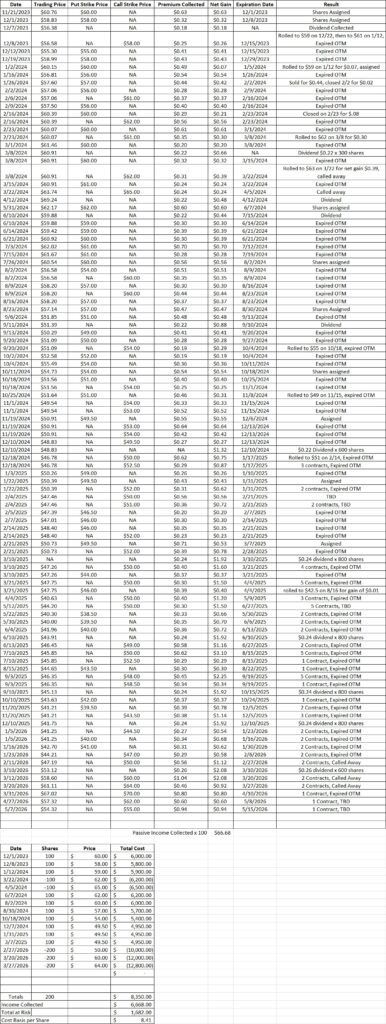
The attack on Iran has caused a spike in oil prices. We’d like to continue to take advantage of the elevated trading price. We’d like to get our basis down to negative with OXY trading in this elevated range. Let’s recap our stock market trades on OXY so far.
We sold some cash secured put option contracts and collected option premium for monthly cash flow. Those put options gave us obligations to buy shares of OXY if the price movement went below our strike price. We kept that premium as income, and we were assigned shares. Then we sold more puts below the trading price and also some covered calls on a portion of our position. OXY traded in a range above our put strike and below our call strike, so both sets of contracts expired out of the money. We kept the option premium, and then sold another set of puts below the trading price. We also sold covered calls above the trading price. This options trading strategy enabled us to collect option premium on both sides of the trading price.
The trading price of OXY eventually dropped and we were assigned more shares. Then we sold more covered calls on a portion of our position. We also sold more put options. As we continued this process for the last couple years, we were continually selling puts below the trading price and covered calls above the trading price. We used the option premium from these trades to reduce our basis per share. When the trading price of OXY began to run up we stopped selling puts because OXY was no longer trading in a range where we wanted to acquire more shares. We had some shares called away at strikes that were above our cost basis, and that dropped our cost basis on the shares we continued to hold. We’ve repeated that process several times, and hold 200 shares with a basis of $8.88 per share with OXY trading at $54.32.
Today we’re going to sell to open a covered call option contract for the 5/15 expiration date. This simple options trade for weekly income will give us cash flow and reduce our basis per share. Weekly and monthly options contracts expire on the third Friday of the month, and that can mean more trading volume for option contracts that expire on the third Friday.
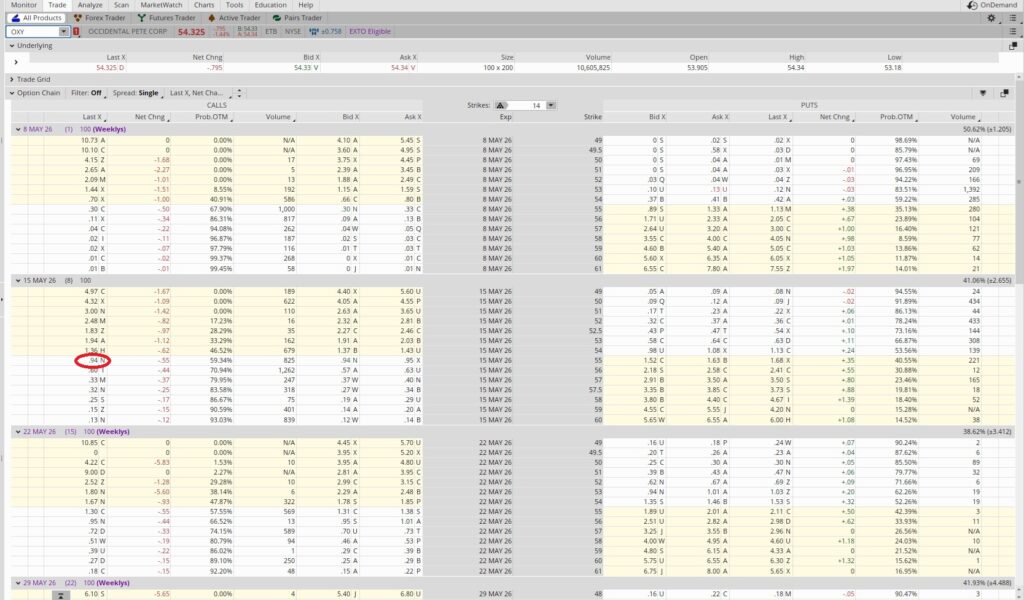
We can see the call option contract for the 5/15 expiration date on the option chain below. The call option for the $55 strike price has a Bid of $0.94 and an Ask of $0.95. If we sell to open this call option contract we’re making a promise to the buyer of the contract that we will sell our shares at the $55 strike price. We’ll still keep the option premium, which means our effective sale price will be about $55.94. That could happen on or before the expiration date. If the trading price of OXY stays below our $55 strike the time decay of the option premium will result in the contract expiring out of the money worthless.
We’re doing this trade to create some weekly cash flow with options trading. It also fits our risk tolerance. If the trading price of OXY stays below our $55 strike we’ll keep the shares, and we’re ok with that. And if the trading price of OXY goes above our $55 strike price we’ll have the choice of either letting the shares go at $55 or rolling out of the position. If we choose to roll out of the position we’ll buy to close the existing contract. Then we’ll sell to open a new contract with a higher strike price and an expiration date that is further out in time. Ideally that new contract would cover the cost to close the existing contract. At this point we’re thinking we’d let the shares go if the trading price is about our strike price on the expiration date.
We sold to open the call option contract at the $55 strike price for the 5/15 expiration date for $0.94. That simple options trade for weekly income brings our cost basis down to $8.41 per share. If our shares are called away at $55 it will bring our basis negative. So we’ll have extracted all of our initial investment capital that we had put into OXY. We’ll also have made money on those trades, and we’ll still hold shares. Then we can plan to hold those shares for the long term and collect a quarterly dividend in perpetuity. We could also continue to sell covered calls to generate weekly cash flow. Here is our trade history on OXY.