Yields an Income Each Month
The option trade we’re going to walk through today yields an income each month. Lately we’ve been using a wheel option strategy on BLDR. Since the daily trading volume for BLDR isn’t too high it doesn’t have weekly option contracts available. It does have monthly option contracts, and that’s what we’ll use to generate passive income. Here is a link to our most recent post on BLDR option trades. Here are examples of wheel option trades we’ve done on other companies.
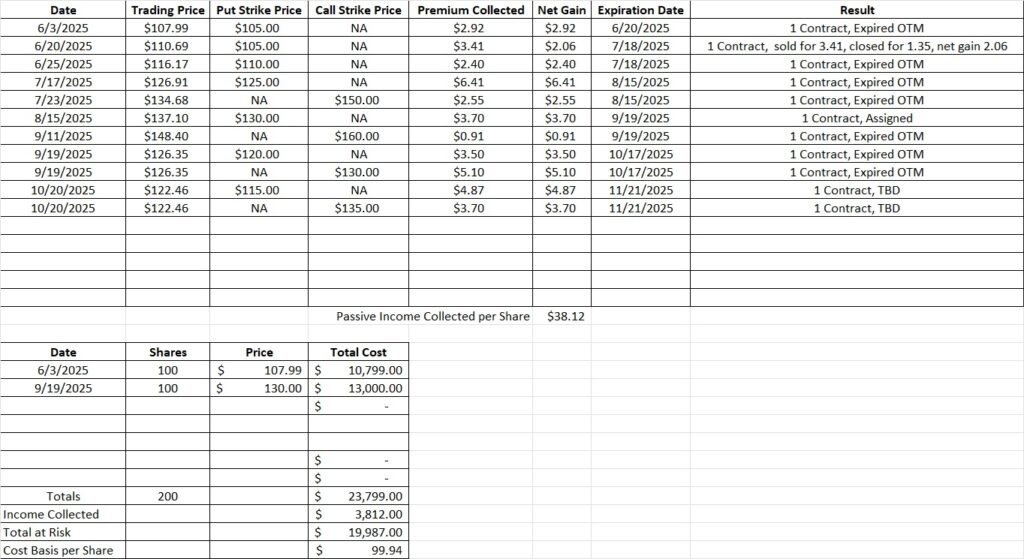
We currently hold 200 shares of BLDR in this portfolio with a basis of $104.22 per share. We bought 100 shares back on 6/3 at $107.99 per share. Then we’ve sold cash secured put options just below the money each month. We were assigned another 100 shares at the $130 strike on 9/19. Each time we sell a put option we bring in option premium. And each time we sell a covered call option we bring in more option premium. That option premium yields an income each month. Since we have 200 shares, we can sell one covered call option contract to collect more option premium each month. If the trading price of BLDR runs up through our call strike we can either let the shares go or roll the position.
If we sell the shares at the call strike we’ll make money on the sale of the shares. Even though we’ll be selling our shares at the same strike price that we bought the shares, we collected option premium when we sold to open the put option on those shares and also on the covered call option. Let’s walk through an example.
We currently own 200 shares with a basis of $104.22 per share. That works out to an allocation of about $21,000 to BLDR right now. In this portfolio we’re willing to put up to $60,000 to BLDR, so we have plenty of room for more shares. We’re not going to fill up right here, but we will sell to open another cash secured put option. When we sell a put option we’re making a promise to buy 100 shares of the underlying security at the strike price on or before the expiration date. That means we need to have at least 100 times the strike price available in our account to make this trade. It also means we’re locking up that capital through the contract expiration date. So we want to be sure we’re generating an acceptable return on that capital. Here’s how we do that.
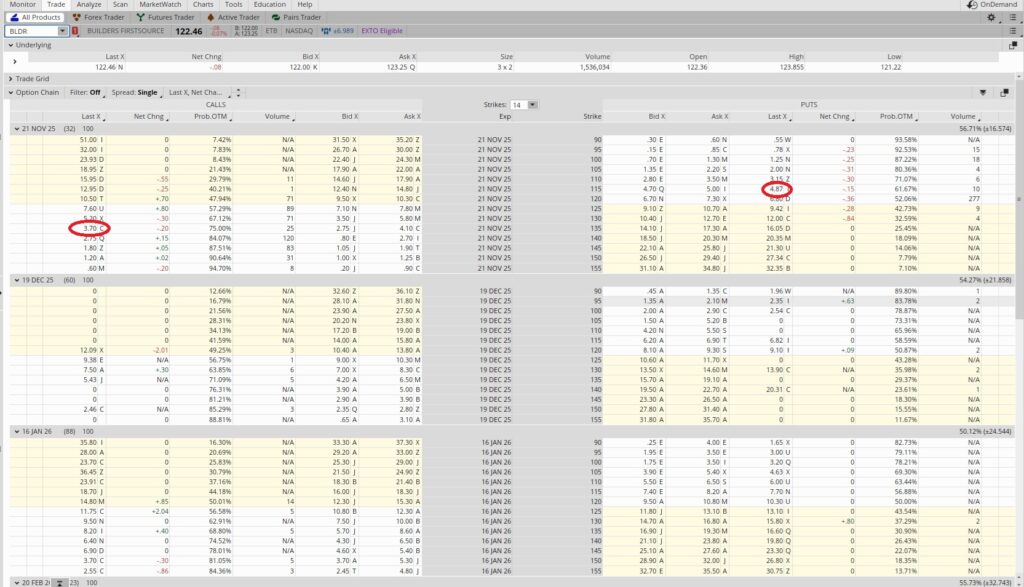
We’re making a promise to buy 100 shares of BLDR at the $115 strike price. We sold to open that contract for $4.87 per share. So we divide that option premium by the strike price and we get 0.042. Then we multiply that by our time period. This trade lasts for one month. There are twelve months in a year, so we could theoretically do this trade, or a similar trade on another company, twelve times over the course of a year. So we multiply our 0.042 by 12 and we get 0.508. So this option trade yields an income of 4.2% monthly, or 50.8% annualized. If the trading price of BLDR drops below $115 we’re committed to buying the shares. If BLDR continues to trade above $115 this put option will expire out of the money worthless. Either way, we keep the $4.87 per share in option premium.
We’re also going to sell to open a covered call option contract. We own 200 shares of BLDR in this portfolio and we’d like to hold some for the run up in price. So we’re only selling to open one covered call option contract. When we sell to open a covered call we’re making a promise to sell shares of the underlying company at the strike price on or before the option contract expiration date. Since our basis is $104.22 per share we can sell a covered call at any strike above that and make money on the sale if the shares are called away. We could also roll the position to a different strike price on an expiration date that is further out in time if we prefer to keep the shares.
With BLDR trading at $122 today we can sell the $135 covered call option for the 11/21 expiration date for $3.70 per share. That strike is about 10% higher than the current trading price. That means BLDR needs a substantial move up for our call to go in the money. If that happens we should be able to buy to close this contract and then sell to open another one with a higher strike price and a new expiration date. This trade also yields an income on both sides of the trading price. This brings our cost basis per share on BLDR down to $99.94. Here is the template we use for tracking our cost basis. Here’s the option contract return calculator we use.