Trade Options for Income
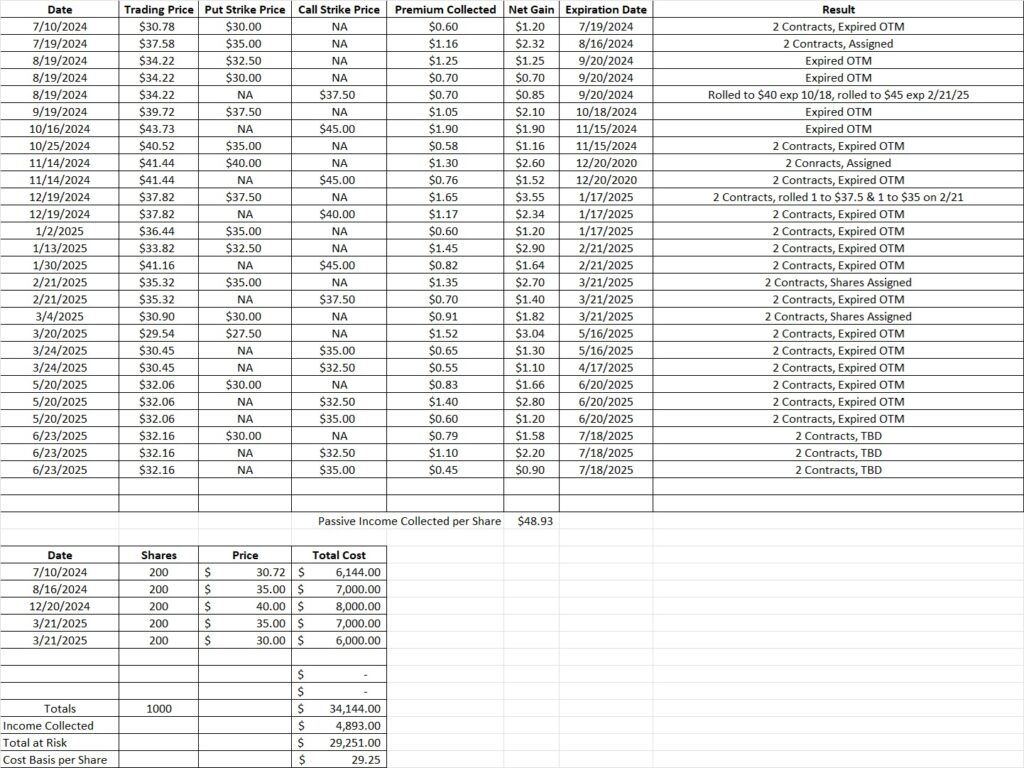
We’re using MBUU to trade options for income. Remember that we’re only selling puts on MBUU because we’re happy to own the company in this price range. Here’s the post that walks through why we like the company. We currently own 1,000 shares of MBUU in this portfolio with a basis of $29.72 per share.
MBUU has a lower trading volume and they only have monthly option contracts available. Last month we were short the $30 put, the $32.50 covered call and the $35 covered call. Here’s the post that walks through how we put on those options trades. When we sell to open an option contract we collect option premium as passive income. We keep that option premium regardless of what happens with the option contract. In this case, MBUU ended the trading period last Friday at $31.55. That was above our $30 put strike and below our call strikes at $35 and $32.50. So we collected the premium as passive income and the option contracts expired out of the money worthless. Now we’ll repeat that process to trade options for income. We can sell more cash secured put options and covered calls to generate more cash flow.
We’re comfortable adding more shares to our position in this price range so we’re going to sell some put options. With MBUU trading at $32.16 right now we’re in a profitable position. We have three reasonable choices for a put option strike. We could sell the $27.50, the $30, or the $32.50 strike. The $27.50 is too far away from the money to generate much premium. The $32.50 has lots of premium, but is in the money. Since we already have 1,000 shares of MBUU we aren’t going to be super aggressive in adding to our position. That leaves us with the $30 put option strike.
When we sell to open a put option contract we need to have enough capital in our brokerage account to cover the cost of the shares in case of assignment. One contract is for 100 shares, and in this case the put is the $30 strike. So 100 x $30 is $3,000. We need $3,000 in our account to cover the shares for each put option contract we sell to open. If we sell to open two contracts, we’ll need $6,000. When we trade options for income we want to be sure we’re generating an acceptable level of return. Let’s walk through how we gauge a profitable options trade.
This put option contract has a duration of one month. There are twelve months in a year, so we could do this trade, or a similar trade on a different company, twelve times over the course of one year. Then we look at the strike price, which is the capital we’re risking by selling to open the put option. We also look at the option premium we’ll bring when we sell to open the contract.
We brought in $0.79 per share and we’re risking $30 per share. So we divide the $0.79 by the $30 strike price and we get 0.026. Then we multiply that by our time multiplier, which is 12. That gives us 0.316. That’s an annualized return of 31.6%. When we trade options for income we want to get paid a reasonable amount to do what we want to do. In this case, getting a 31% annualized return to buy a company we want to buy at the price we want to buy sounds like a good plan for us. Here is the options trading calculator we use to help us evaluate our return on capital. We did two contracts on this trade.
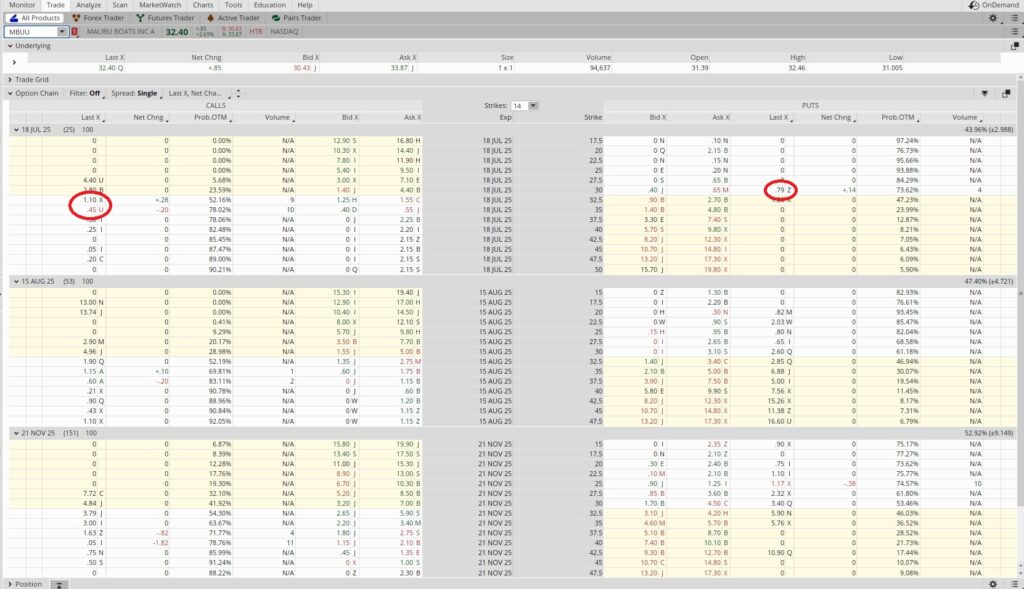
We also sold to open four contracts of covered calls, two each at the $32.50 and $35 strikes. Thos contracts are also for the 7/18 expiration date. On the $32.50 strike we brought in $1.10 per contract in option premium. On the $35 strike we brought in $0.45 per contract.
When we trade options for income we want to work both sides of the trade when possible. We’re using the option premium for cash flow so we continue selling puts just below the money and calls just above the money. We’ll do this over and over again until the underlying company rises above our purchase price. At that point we’ll stop selling puts to generate passive income. We’ll continue to sell calls on a portion of our position. If the underlying company runs up through our strike price and we get called away we’ll still own some shares. We could also roll the position up to a higher strike price at an expiration date that is further out in time.
Trade Recap
We hold 1,000 shares of MBUU in this portfolio with a basis of $29.72 per share. We had two puts at the $30 strike that expired out of the money last Friday, along with two calls at the $32.50 strike and two calls at the $35 strike expire out of the money. Today we sold each of those contracts again for the 7/18 expiration date. On the $30 put option we brought in $0.79 per share in passive income with the option premium. On the $32.50 call strike we brought in $1.10 per share and on the $35 strike we brought in $0.45 per share. These option trades reduced our basis in MBUU to $29.25 per share.