Create Consistent Trading Profits
Today we’re going to walk through a trade we do to create consistent trading profits. Trades like this are how we use option trading for income. We currently own 200 shares of CROX in this portfolio with a basis of $79.42 per share. We have room for about four more tranches. In this portfolio 100 shares of CROX equates to about one tranche, so we’re trading one option contract at a time. Here’s our most recent post on our CROX trades.
Our cash secured put option at the $83 strike was in the money at expiration. We took the shares at $83, then sold to open a covered call on those shares. Our covered call is at the $89 strike and expires on Friday, 10/10. Since CROX dropped quickly these last few days we’re now going to sell to open another put option for passive income. We like to sell puts on down days to give us more premium than normal. That, along with selling covered calls on up days, helps us create consistent trading profits. We do this on companies that are trading at a price we’re happy to buy them.
Our capital allocation with this strategy is to break up the capital we want to allocate to this company into five our six tranches. Then we sell a cash secured put option just below the money on a tranche. If the trade expires worthless out of the money we’ll sell another put option. We’ll repeat that process until we’re assigned shares. By the time we own shares we’ve usually built some equity in our position from selling the put options. Then we’ll continue selling put options further down if the trading price continues to drop.
We’ll also sell covered calls on some, but not all, of the shares we own. This way we’re collecting option premium on both sides of the trading price. If the trading price drops we could be obligated to buy more shares, so we only use this method on a company we want to own in this price range. If the trading price quickly runs up through our call strike we’ll have the choice of selling the shares at a profit or rolling the trade. This is the process we use to create consistent trading profits.
With CROX trading down today we’re going to sell to open a cash secured put option contract. Since we have room for at least three more tranches of CROX in this portfolio we can be pretty aggressive with our put strike. We’d like to bring in some option premium for cash flow and also to reduce our basis in the shares we already own. If we are assigned shares that will also reduce our basis as we dollar cost average down into our position. When we sell a put option we’re making a promise to buy shares at the strike price. It also ties up our capital for the duration of the contract. We want to be sure we’re receiving an acceptable level of return on that capital. Here’s how we do that.
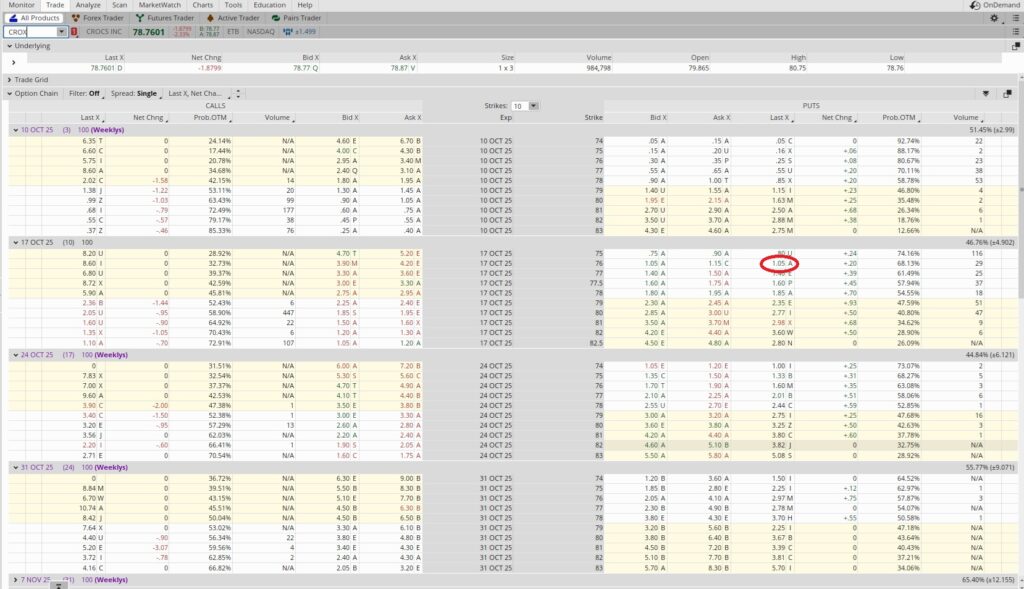
We sold to open the $76 put for the 10/17 expiration date. Today is 10/7, which means this trade will be active for 10 days. There are 365 days in a year, so that makes our time multiplier 36.5. Then we divide the option premium by the strike price. In this case that’s $1.05 by $77. That gives us 0.0136. Then we multiply that by our time multiplier and we get 0.498. That’s an annualized return of 49.8% on the capital we’re risking on this option contract. Here’s the option return calculator tool we use to help do that calculation.
Weekly Option Trade Recap
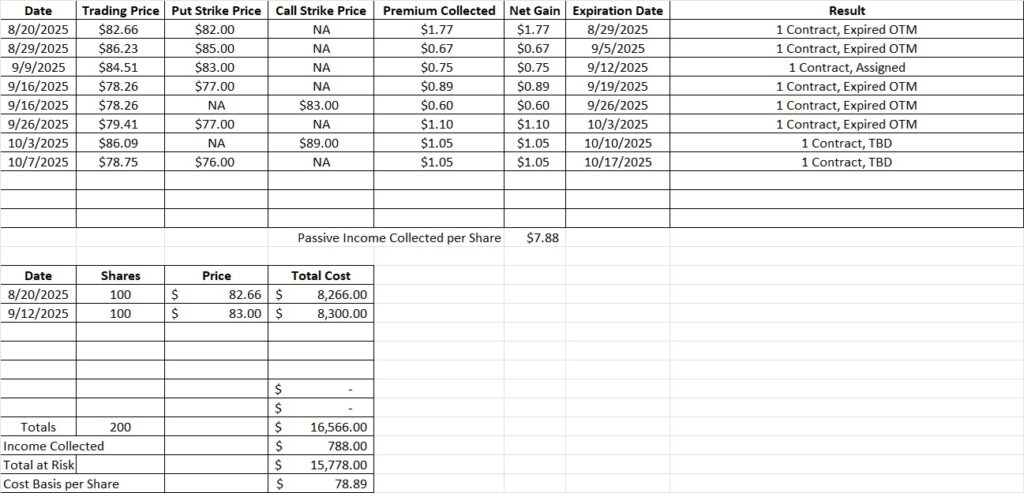
We currently own 200 shares of CROX with a basis of $79.42 per share. We sold to open the $76 put option for the 10/17 expiration date for $1.05 per share. That reduces our basis down to $78.89 per share. If CROX drops below our strike we have the choice to either take the shares at $76 or roll the trade to a lower strike. Here is the basis reduction template we use to track our cost basis and trade history. We can create consistent trading profits using option premium like this to create cash flow.