
Sell Covered Calls for Income
Today we’re going to sell covered calls for income. We currently own 300 shares of RGR in this portfolio with a basis of $33.10 per share. Here’s a link to one of our recent posts on our RGR options trades. We’ve been selling covered calls above the trading price and put option contracts below the trading price. RGR was trading in the mid $30’s for most of the summer. Since it’s a lower volume security there are only option strikes in $5 increments and only on monthly contracts. That limits the trades we can do and still generate an acceptable level of return on our capital. Now RGR is trading in the mid $40’s and we’re going to sell covered calls for income.
When we sell a covered call option contract we’re making a promise to sell 100 shares at the strike price on or before the expiration date. So we want to be sure the strike price we select is at or above our basis. Since our basis is $33.10 per share, we need to pick a strike price that is above that. If RGR is trading above our strike price at expiration we’ll be obligated to sell our shares at the strike price. We could also adjust the position. To do that we would buy to close the current contract. Then we would sell to open a new one with a different strike price and an expiration date that is further out in time. If we do that we’ll want the premium we receive for opening the new contract to make up for what it cost to close the current contract.
We can see that RGR is up over 2% today and is currently trading at $46.11. The closest strike that is above the current trading price is the $50 strike. Since we have 300 shares we can sell to open two covered calls at that $50 strike. If RGR continues up and goes above our strike price we could let the shares go at $50. That would bring in $10,000, which would reduce our basis on our remaining shares down below zero. That means we’ll have gotten all of the money we put into RGR back out of it, and we’ll still own 100 shares of the company. We can hold those last 100 shares indefinitely and continue to collect the quarterly dividend. When we sell covered calls for income we also bring in the option premium for additional revenue.
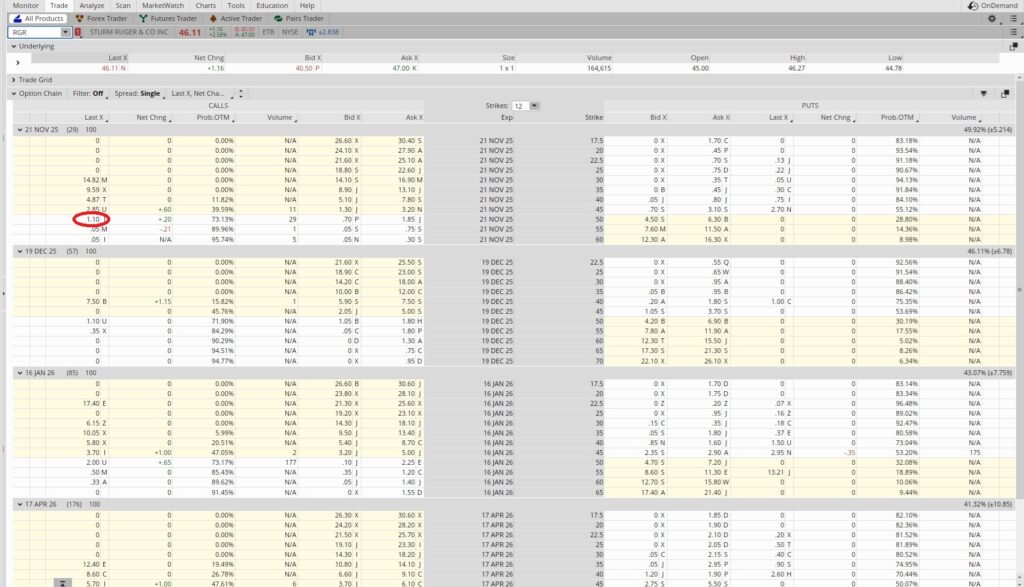
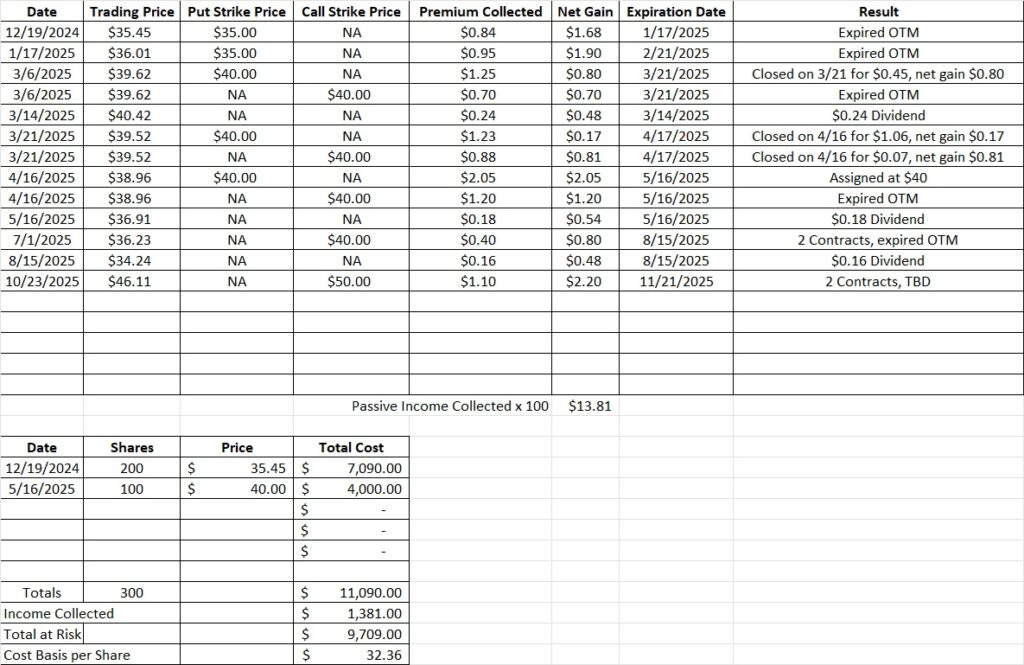
We sold to open two contracts of the $50 covered call option for the 11/21 expiration date. We brought in $1.10 per share in passive income on each contract for a total of $220. That reduces our basis on our 300 shares down to $32.36 per share. The idea with this trade is to use the option premium to reduce our basis. So we sell covered calls for income, which will give us monthly cash flow. We’ll reduce our basis each month with that option premium. If RGR runs up through our strike and we have shares called away, we’ll be selling shares above our cost basis so we’ll be selling shares at a profit. Here’s the template we use to track our cost basis per share and our trade history.
We typically sell puts below the money and covered calls above the money to earn passive income selling options. That approach gives us option premium on both sides of the trading price. The cash secured put option is usually a strike or two below the money and the covered call option is a strike or two above the money. We’ll keep the premium from both sides of the trade regardless of what happens with the trading price. As long as the underlying security trades between our strikes we’ll also keep our shares. If the trading price drops below our put strike we’ll have the obligation to buy more shares. That’s why we need to be comfortable buying shares at our put option strike price. Here are examples of these types of wheel option trades on other companies.
In this case we’re only selling covered calls because we feel that $45 is too much to pay for shares of RGR. The $40 put strike does not offer enough option premium to make that put option contract a worthwhile use of our capital.