Beginner Options Strategy
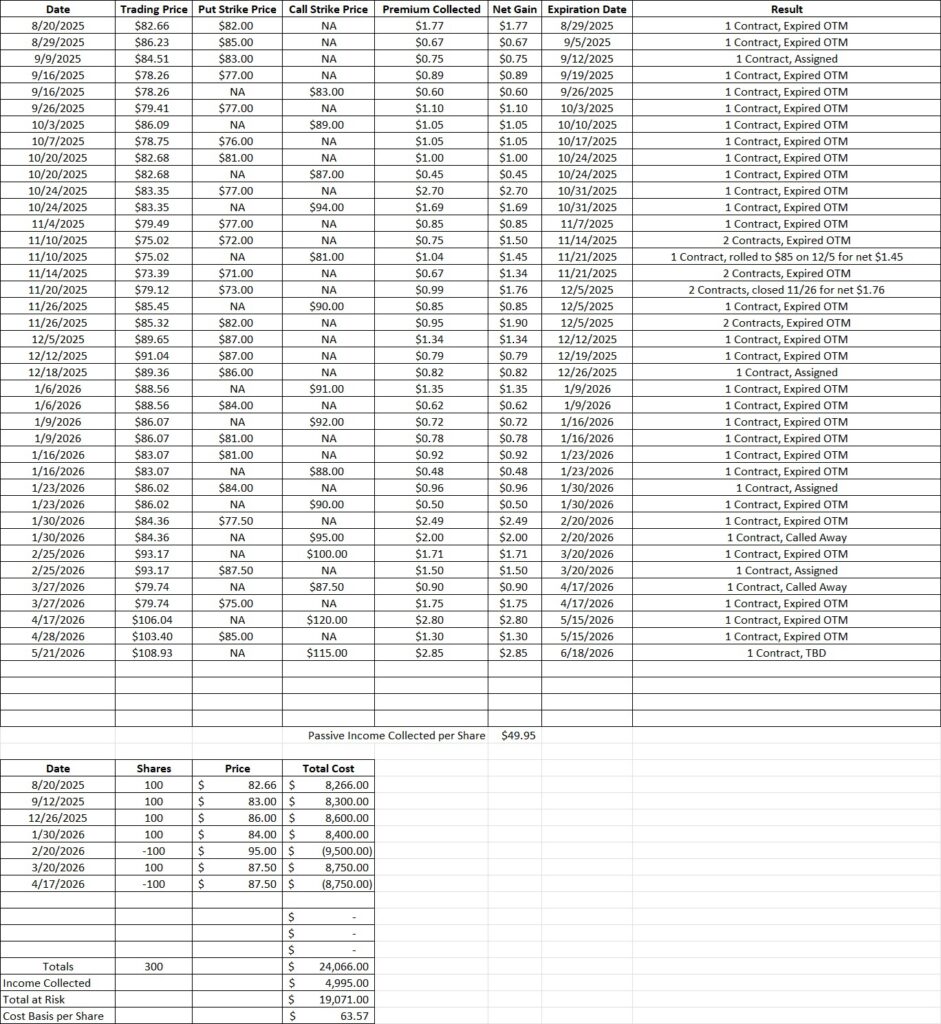
Let’s walk through the beginner options strategy we’ve been using to create consistent monthly cash flow in the stock market. We currently own 300 shares of CROX in this portfolio with a basis of $64.52 per share. Our lowest purchase price of shares was $82.66. CROX is trading over $108 per share today, so we’re in a profitable stock trading position right now. Let’s walk through the trading strategy we used to reduce our basis below our purchase price for the stock. In short, we like to use derivatives to profit from our decision to buy or sell a company or index fund rather than just buying shares outright. As long as we have the risk tolerance for this simple investment strategy we can use this trading plan to create consistent monthly cash flow. Some of our recent posts outlining our options trades on CROX are availablehere and here.
We sold to open some put option contracts and collect option premium when we entered those trades. Selling a put option gives us the obligation to buy shares at the contract strike price. Since we want to own shares of CROX for the long term, we’re fine with agreeing to that obligation. We did that a few times and collected option premium with each monthly option trade. Most of those contracts were out of the money on the expiration date, so we kept the option premium. Then we sold to open another put option for the next expiration date. By selling options for income this way we were able to use the option premium to reduce the basis of the shares we own. Eventually the price movement brought the trading price below our put option strike price and we were assigned shares of CROX.
Once we had some shares we sold to open a covered call option contract on a portion of those shares. The strike price of our call options was at or above our assignment strike price. That way we would at least break even on the sale of the shares. We’ll also collect passive income from the option premium. We also continued to sell put option contracts with a strike price below the trading price. We brought in passive income below the trading range from the put option. Then we brought in option premium from the covered calls, so we were able to generate passive income selling stock options on both sides of the trading range. Now CROX is trading above our buy price range, but we can still use covered calls to create passive income with monthly options trades.
One option contract represents 100 shares of the underlying security. Since we have 300 shares of CROX we can sell one or two covered calls for the expiration date on the third Friday of the next month and still be assured of holding some shares. We prefer to sell calls on only a portion of our position in case the trading price runs up through our call strike and we have shares called away. While that will reduce our basis, we also want to hold some shares for the long term. Ideally we’ll reduce our basis to zero or even negative, and we’ll still own shares of the company. Then we can hold those shares indefinitely while we redeploy that capital elsewhere. More detail on this passive income strategy for accredited investors is available here.
Let’s look at the recent price movement of CROX. We can see a line of resistance around $110 per share, and another line around $113. If we sell a covered call at the $115 strike we can hope that the resistance lines at $110 and $113 will slow down an upward price move. We don’t need those resistance levels to stop the price, just slow it down long enough that our call option contract expires out of the money on the third Friday of the month. If the trading price of CROX runs up through the $115 strike we’ll have the choice to either sell the shares at $115 each or roll the position.
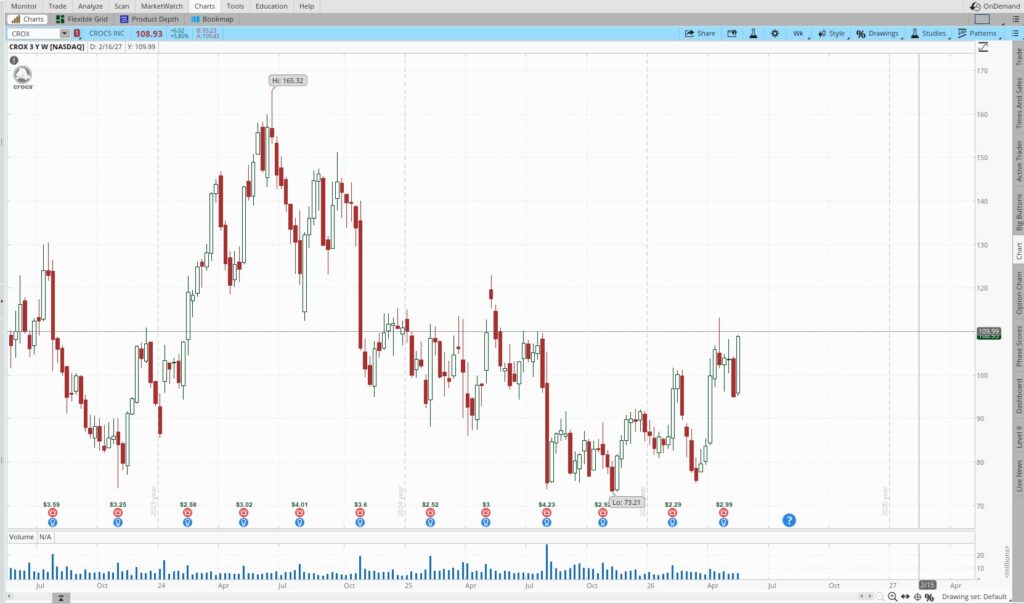
Rolling the position would mean we buy to close our contract at the $115 strike and then sell to open another call option contract with a higher strike price that is further out in time. Ideally, the premium we receive in selling to open that next contract would be enough to cover the cost of closing the contract at the $115 strike. Since our cost basis is currently $64.52 per share, selling some shares at $115 would net us $50.48 per share in profit. We’d be happy with that. So if CROX runs up through our call strike price we’ll likely just let the shares go. Until that happens, we’ll sell the covered call as a cash flow options trade. We’ll collect and keep option premium, and we may even get to keep our shares. Then we would be able to sell another covered call for passive income next month.
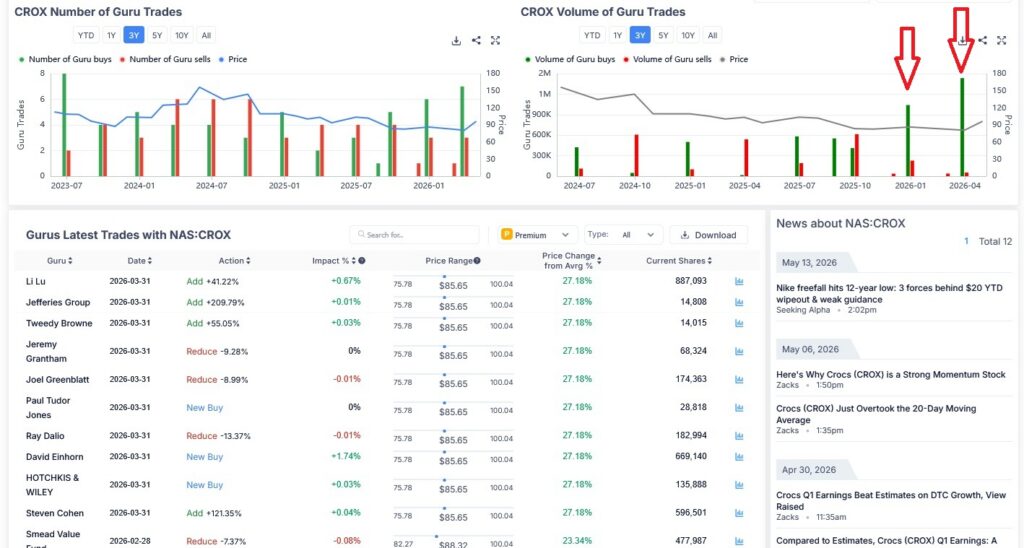
The quarterly 13F filings just came out for the first quarter of this year. We can see lots of buying of CROX by the larger hedge funds over the last two quarter. We can see total purchases of 1,040,706 shares to sales of 227,132 shares in 4Q25. In 1Q26 that ratio was even stronger, with 1,434,802 purchases to just 52,452 buys. More detail on how we use 13F filings to monitor what the big hedge funds are doing is available here.
Now let’s look at the option chain for CROX. They recently switched from available weekly option contracts to just monthly option contracts. After looking at the price share we’d like to be above the $113 resistance level. We’ve also seen CROX run up from a low of $94.80 per share last Friday. Now it’s over $108 just minutes from market close on 5/21. That’s a substantial upward move. It may continue, and if we get shares called away at $115 we’re ok with it.
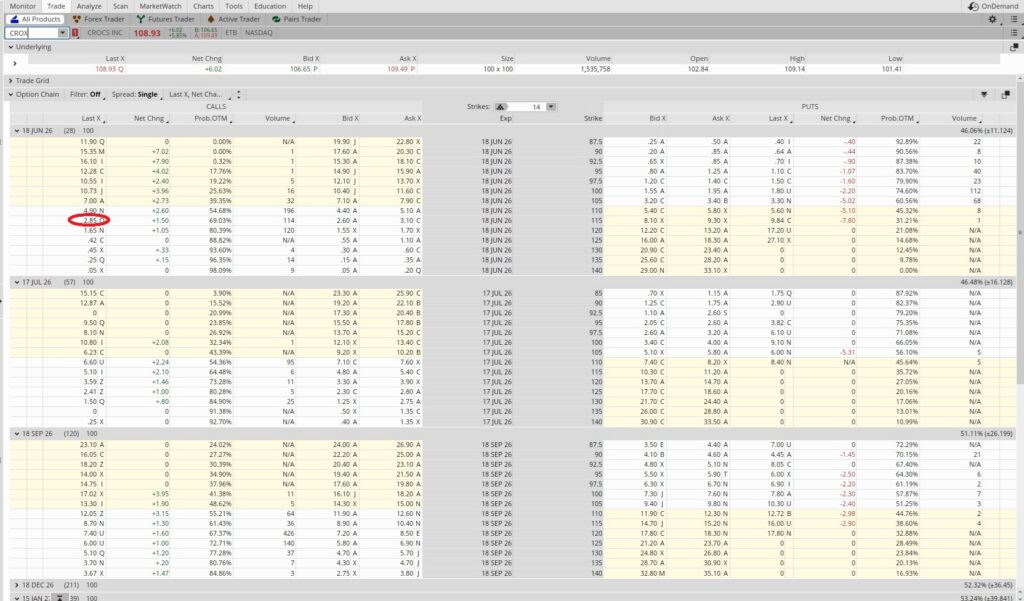
We can see the $115 call strike for the 6/18 expiration date with a mark of $2.85. We can sell to open that covered call contract and bring in $285. That will reduce our basis on our 300 shares down to $63.57 per share. If the trading price of CROX stays below $115 through the expiration date we’ll keep both that option premium from the time decay and our shares. If the trading rises through our $115 strike price we’ll still keep that premium and then we’ll sell the shares for a gain of $50+ per share. That would then bring our basis on our remaining two hundred shares down to $37.86 per share. Either way we’re in a solid position. Here’s a link to the basis tracking template we used below.