Consistent Income Selling Options
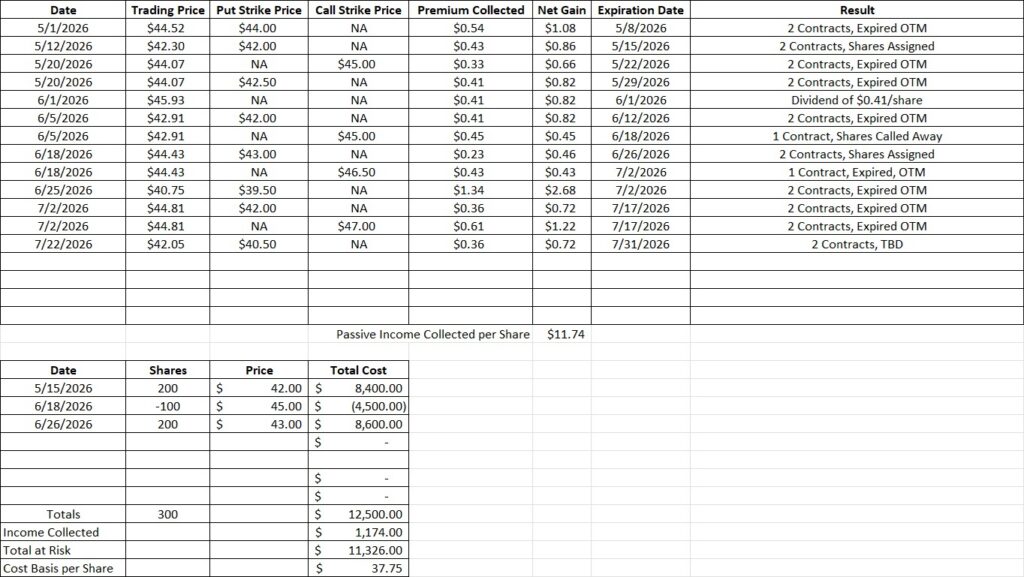
Lately we’ve been creating consistent income selling options on NKE. We’re doing these trades on NKE because it’s trading at a price we’re comfortable buying shares. It also has a dividend of $0.41 per quarter, which gives us a yield of 3.9% at today’s trading price. Here’s a link to one of our recent trades on NKE. We currently hold 300 shares of NKE in this portfolio with a basis of $37.63 per share. We’re going to do some more trades to create cash flow on the shares we own. We’re happy to buy more shares in this price range, and we’re also ok with selling some of our shares here. Our overall objective is to use the option premium to create cash flow. We’d like to acquire some shares to hold for the long term in the process.
Our last two trades on NKE expired out of the money. We sold to open a cash secured put option contract at the $42 strike for the 7/17 expiration date. That contract gave us the obligation to buy shares at the $42 strike price. We also sold to open a covered call option contract at the $47 strike. The covered call option contract gave us the obligation to sell shares at the $47 strike price. NKE closed trading last Friday, 7/17 at $43.76 per share. Since our put strike was below that and our call strike was above that, both trades expired worthless. We pocket that option premium and use it to reduce our basis. Here’s a link that goes deeper into how we use this trading strategy to create consistent cash flow with weekly options trades.
Today we’re going to sell to open a put option with a strike that is just below the trading price. With NKE trading at $42.05 right now we want a strike that is below $42. We currently hold 300 shares, so we don’t need to be overly aggressive with how close our strike is to the money. Our main goal is to create consistent income selling options. When we sell to open a cash secured put option contract we’re creating an obligation that we’ll buy 100 shares of the company at the strike price. That could happen on or before the expiration date. The party buying the put option will only exercise the option contract if the trading price is below the put strike price. So as long as NKE continues to trade above the strike price through the expiration date, our contract will expire out of the money.
If the trading price drops below our strike price we’ll have the obligation to buy 100 shares of NKE at our strike price. Regardless of the price movement, we keep the option premium we bring in when we sell to open the contract. Since we’re creating the obligation to buy shares, we need to have enough capital in our trading account to cover the cost of buying 100 shares of the company in case the trading price drops and we get assigned shares. So if we sell a put option contract at the $41 strike, we’ll need 100 x $41, or $4,100. And we need that available in our trading account for each contract we sell. If we sell two contracts, we’ll need $8,200. NKE’s earnings call was on 6/30, so we don’t need to worry about a surprise on an earnings call during this trade.
When we sell a put option we’re locking up that capital for the duration of the contract. We want to be sure we’re generating an acceptable level of return while we tie up that capital. We like to use a formula to compare option contracts when we select our strike. The first thing we do is look at the duration of the trade. A contract that expires on 7/31 has an expiration date that is nine days away. There are 365 days in a year, so we divide 365 by 9 and we get 40.6. That means we can do a trade with a duration of 9 days 40 times over the course of a year. That’s the first part of our formula.
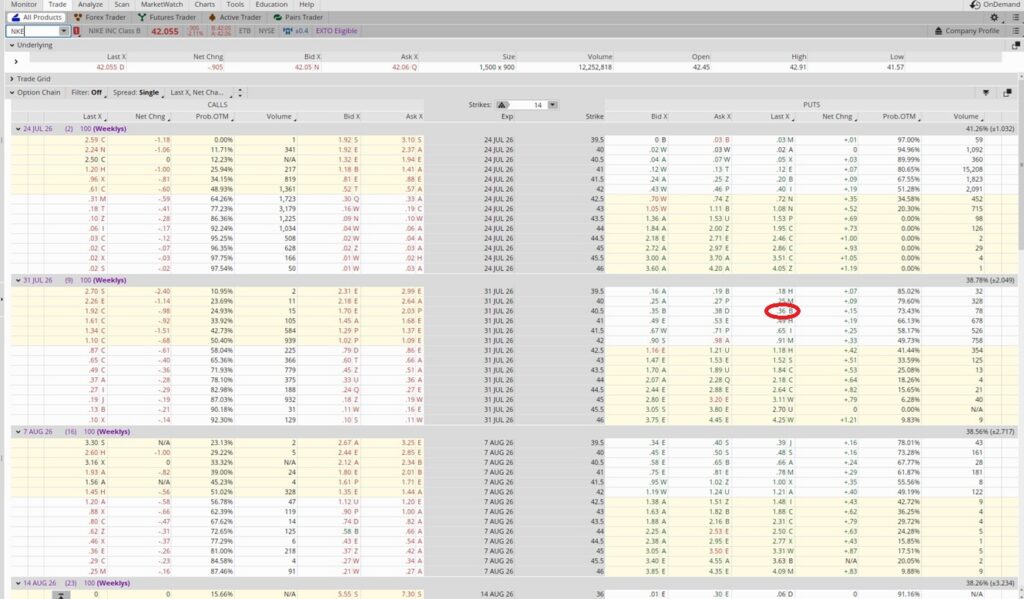
The second part of our formula is the option premium component. We take the option premium we receive when we enter the trade and divide it by the strike price. Right now we’re looking at the $40.50 strike with a premium of $0.36. We divide the $0.36 in option premium by the $40.50 strike and we get 0.0089. That’s our return on the capital we’re risking. Then we multiply that by our time period for the duration of the trade to give us our annualized return. So 0.0089 times 40.6 is 0.361. That’s an annualized return of 36.1% on the capital we’re locking up when we sell to open this put option contract. That’s good enough for us, and we sold to open two put contracts. Here’s the option contract calculator tool we use to help with that.
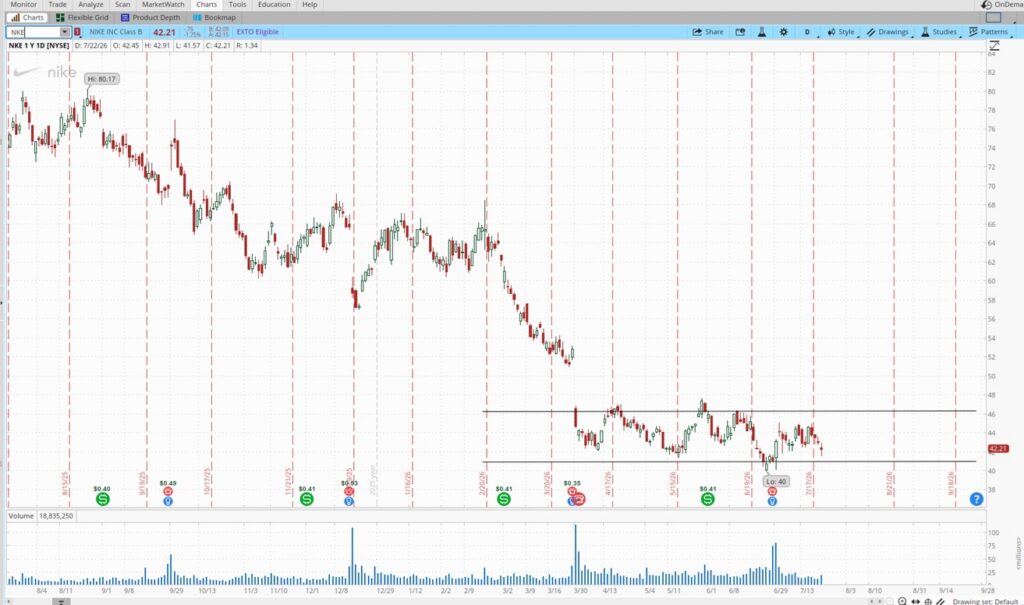
We can also see that NKE is trading near a support line right now. It’s at the bottom end of the it’s recent trading range of $42 to $46. So while we’re going to sell to open a put option, we’re going to hold off on selling a call. We may sell a covered call on some of our shares if NKE bounces off the lower end of the trading range and runs up near the top of the trading range. But we don’t want to get caught holding a call with a strike that is in the middle of the trading range.
Weekly Trade Recap
We hold 300 shares of NKE with a basis of $37.63 per share. We sold to open two put option contracts at the $40.50 strike price for the 7/31 expiration date. This weekly option trade gives us cash flow and brings our basis down to $37.75 per share. If the trade expires out of the money we’ll be at $37.75 per share. If the trading price drops through our $40.50 strike and we’re assigned our new basis will be $38.85 per share. That may happen. If it does, we can be more aggressive selling covered calls on a portion of the position to reduce our basis further. We’re holding off on selling a call right now because NKE is at the bottom of its recent price range. If NKE moves higher we’ll sell a covered call when the trading price is near the upper end of the recent trading range.