Play Beat the Clock for Profit by Selling Options
Today we’re going to walk through our trading strategy, which is to play beat the clock for profit by selling options. We currently hold 200 shares of UPS in this portfolio with a cost basis of $65.43 per share. We had 100 shares called away on Friday, 7/22. Here’s a link to the post where we walked through that simple options trade. We sold to open a covered call at the $123 strike price and that trade looks favorable so far. UPS had their earnings call earlier this week and, even though they beat on both revenue and earnings, their share price dropped. Now it’s in the range where we’re comfortable selling cash secured put options again.
This time our weekly options trade is a strangle option strategy. That means we’re selling a covered call above the current trading price and a cash secured put option contract below the trading price. As long as the company continues to trade below our call strike and above our put option strike we’ll keep our shares and not buy any new ones. If the trading price rises up through our call strike we’ll sell shares at our call strike. If the trading price drops down through our put strike we’ll have the obligation to buy shares at our put strike. We’re going to be a bit more aggressive with our put strike because we’ve worked our basis down quite a bit. We’ll still be in a profitable position on the trade if we take more shares on our put option contract. Either way, we’ll collect and keep the option premium.
On the price chart below we can see UPS trading today around $105 per share. We have the Fibonacci lines on the chart, and we can see a line at $102.30. The price action has bumped into this resistance line a few times, so with any luck it will bump into and pull back again. If not, we’re happy to buy more shares at the $102 strike.
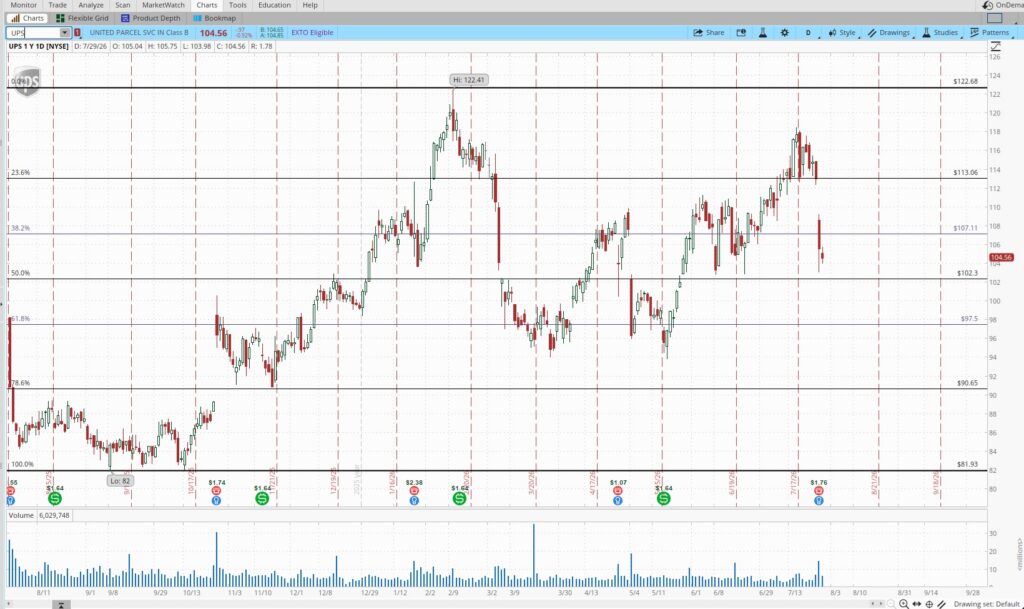
We’re going to be a bit more aggressive in selecting this strike because we’d like to get more shares of UPS. While they have not yet announced the ex-dividend date for this quarter, they will have a dividend coming up soon. If we get shares prior to the ex-dividend date we’ll collect the dividend in addition to our option premium. The ex-dividend date is the first day the shares trade without getting credit for the dividend. In May UPS went ex-dividend on 5/18, which was the third Monday of the month. In February UPS went ex-dividend on 2/17, which was the third Tuesday of the month. Last November UPS went ex-dividend on 11/17, which was also the third Monday. We think it’s safe to say that the dividend will be at the start of the third week of August. So we’d like to own our shares prior to that.
Our primary objective with this cash flow trade is to collect the option premium. If our trade expires out of the money worthless on the expiration date we’re fine with that. If the trading price drops and we’re assigned shares, we’re also ok with that. We would not be selling the put option at this strike price if we were not comfortable buying some shares at this price.
This is essentially a game where we play beat the clock for profit by selling options. We sell the put, if we’re assigned shares we’ll sell a covered call at that same strike price. We’ll sell covered calls on those shares until the shares are called away., That may happen the first week, or it may take several months for the shares to be called away. We’ll continue to collect that option premium each week as long as we continue to do these options trades for cash flow. If the put expires out of the money then we’ll sell to open another put option. Each time we do that we collect the premium to help with our monthly cash flow, and we also reduce our cost basis for the shares we hold. Here’s more detail on this passive income strategy.
One put option contract represents 100 shares of the underlying security. We need to have enough capital available in our trading account in case the trading price drops and we need to buy the shares. In this case the strike is $102, so we’ll need 100 x $102 available in our brokerage account for each put option contract we sell to open. That’s $10,200 each. When we sell to open a put option we’re locking up our capital for the duration of the contract. We want to be sure we’re generating an acceptable level of return on that capital. In this case we’re looking at a contract that expires on 8/14. That’s 16 days away. Let’s walk through how we determine our annualized return on our capital.
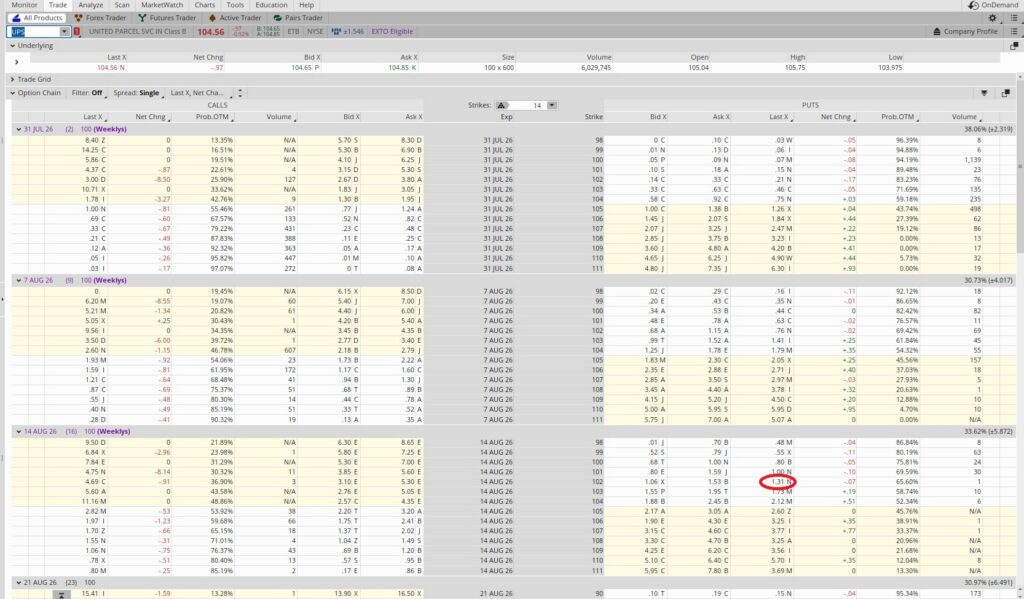
Since this trade lasts for 16 days and there are 365 days in a year, we divide 365 by 16. That give us 22.8. That becomes our time multiplier. Then we look at the capital we’re risking, which is $102 per share. The option premium is $1.31 per share. So we divide the option premium by the strike price we need to hold in reserve to make the trade. That’s $1.31 divided by $102. That gives us 0.013. Then we multiply that by our time multiplier of 22.8 and we get 0.296. That’s a return of 29.6% when we annualize it. That’s good enough for us. Here’s a link to our option contract return calculator that will help with this calculation.
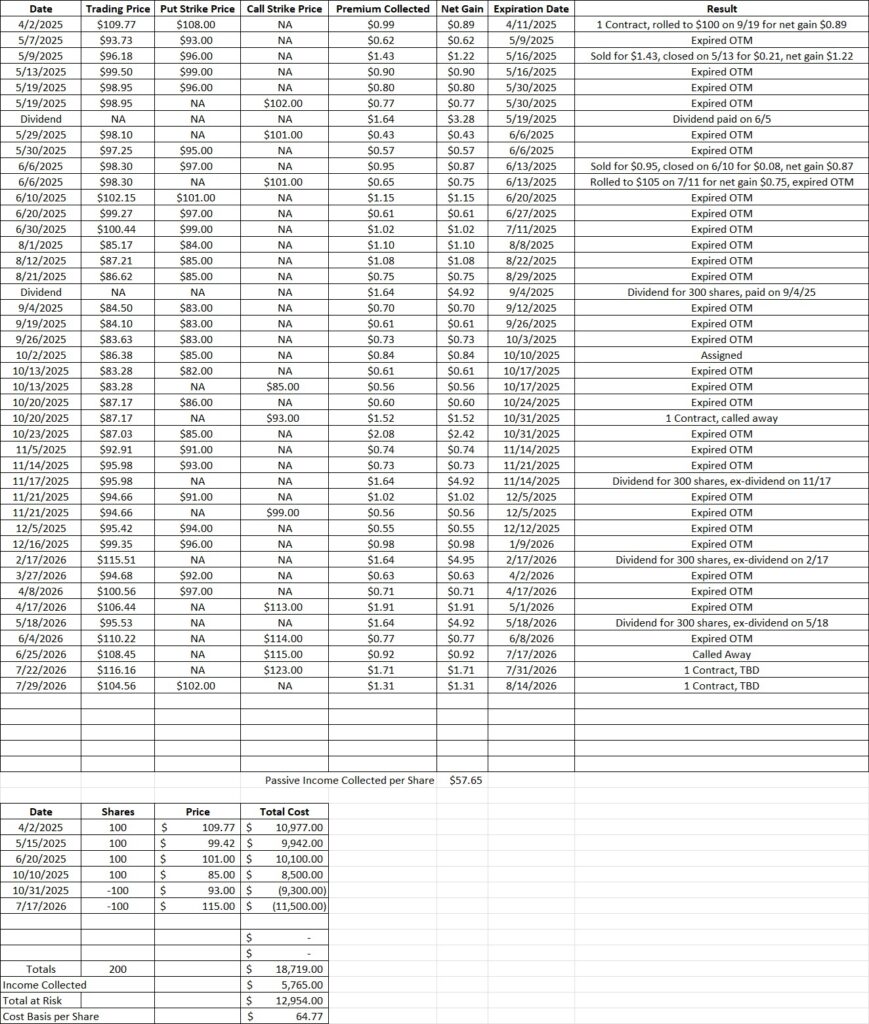
We track our trade history when we sell options for income. We include the option premium we collect as well as any dividends to reduce our basis. Those, along with the purchase dates of shares and the number of shares we hold, will give us a good picture of the passive income we generate selling stock options. Here’s a link to the option contract cost basis template we use.
Weekly Option Trade Recap
Today we sold to open a cash secured put option at the $102 strike price on UPS. The trade is for the 8/14 expiration date. We brought in $1.31 per share in option premium when we sold to open this contract. If the trading price drops below our strike we can either take the shares or adjust the position. If we take the shares our effective purchase price for this tranche will be the $102 strike minus the $1.31 in option premium that we keep, or $100.69 per share. As long as the trading price stays above our $102 strike we’ll keep the option premium without having the obligation to buy shares. This trade brings our cost basis on UPS down to $64.77 per share.