Earn Option Premium
Today we’re going to walk through how we earn option premium with a simple options trading strategy. This type of trade can be done consistently and can be used to generate weekly passive income. Our objective with this weekly options trade is to use the option premium to create a consistent passive income stream without a large time allocation. We currently hold 300 shares of NKE in this portfolio with a basis of $37.49 per share.
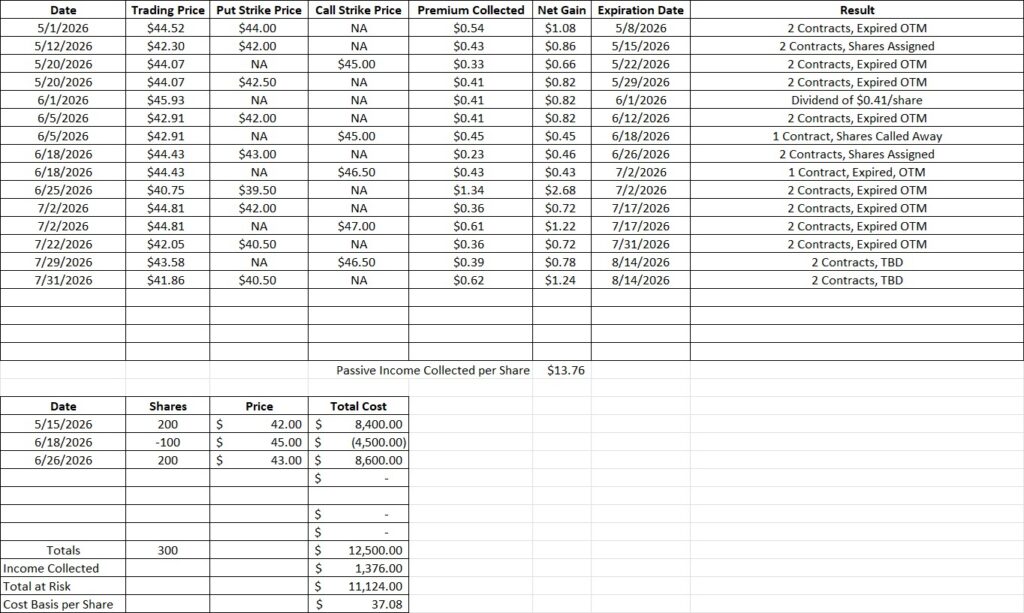
We sold to open two contracts of the put at the $40.50 strike price with today’s expiration date. That trade gave us the opportunity to earn option premium of $0.36 per share on each of those contracts for a total of $72. Those contracts will expire out of the money at market close today. Here’s the post where we talked through that cash flow options trade.
We also sold to open the covered call at the $46.50 strike price for the 8/14 expiration date. That simple options trade brought in $0.39 per share in passive income. Since we sold to open two contracts, we collected $78 in cash flow with that trade. That covered call gives us the obligation to sell 100 shares of the company at that $46.50 strike price. With NKE trading at $41.61 right now we’re in a favorable position on that covered call option contract.
Now we’re going to earn option premium by selling to open a cash secured put option contract. When we sell to open a put option we’re creating an obligation to buy shares of the underlying company at the strike price. We’ll have that obligation from the time we open the contract through market close on the expiration date. One put option represents 100 shares. We’ll need to have 100 times the strike price available in our trading account when we enter the trade. Since we’re locking up the capital for the duration of the contract, we want to evaluate the annualized return on the capital for the trade. That’s a two step process.
The first step is to look at the number of days the trade is active. The duration of the trade is the period between the date we enter into the option contract and the expiration date. Today is Friday, 7/31 and we’re looking at the 8/14 expiration date. That trade lasts for fourteen days, or two weeks. There are 52 weeks in a year, so we could do this trade 26 times in a one year period. So our time multiplier is 26.
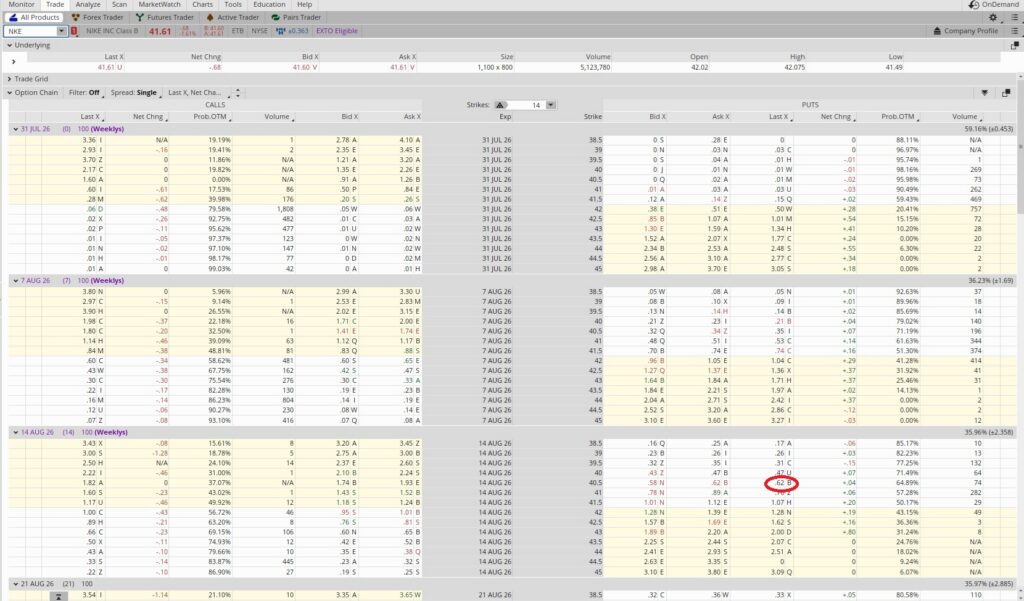
Our second step is to look at the option premium we receive for entering the trade. We compare that to the capital we’re risking on trade. So we divide the option premium into the strike price. Today we’re looking at the $40.50 strike price, and we can see that is trading at $0.62. We divide the $0.62 into the $40.50 strike and we get 0.0153. Then we multiply that by our time multiplier. So the equation is 0.0153 x 26. That equals 0.398. This trade gives us an annualized return of 39.8%. Here’s the option contract return calculator we use when comparing strike prices.
Our premise is to consistently earn option premium making short duration weekly option trades. The time decay accelerates the closer to the end of the contract time period we are. We like to do trades like this for a duration of one month or less because the time decay on the option premium is faster the last few weeks of the contract.
We also break up our capital into sections when we earn option premium making short term trades like this. If we have $50,000 in capital we’re willing to allocate to a company, we’ll only sell puts with a total value of $10,000. That we have room to dollar cost average into a position if there is a downward movement in the price action. In this case, we’re doing two contracts of NKE and we’re willing to allocate a total of about $60,000 to the company. We currently hold 300 shares, so we have plenty of room to add more shares to our position if NKE drops down and starts trading in the $30’s.
Once we hold shares we’ll continue to sell put options with a strike price just below the current trading range. We’ll also sell covered calls on a portion of our position. For the covered calls we like to use the strike price where we were assigned the shares. We’ll sell covered calls on a portion of our position, but not all of our position. If the trading price runs up through our call strike and our shares are called away we like to hold some shares in reserve that we can hold for the long term. If we reduce our basis enough with options premium and dividends, then have some shares called away above our cost basis, we may be able to work our basis down to zero and still hold shares. That’s our ideal scenario. Here’s a post that goes into more detail on this profitable options trading strategy.
While we earn option premium we also like to hold shares to collect the dividend. Adding both the option premium and the dividends, we can quickly reduce our basis on the shares of stock that we own. Here we can see that we collected $0.62 per share on the put that expires on 8/14. We sold to open two contracts. That means we brought in 200 x $0.62, or $124 on this weekly options trade. Add that to the trades we’ve done recently on NKE and we’ve brought our basis down to $37.08 per share. With NKE trading at $41.61 right now, we’re in a profitable position on the trade. We’ll also be in a position to collect the next dividend in early September, so overall we’re happy with our results so far. Here are some of our other recent posts trading options on NKE.
Weekly Options Trade Recap
We sold to open two contracts of the put option at the $40.50 strike price for the 8/14 expiration date. That gave us $0.62 per share in option premium and a total of $124 in passive income on the trade. We also hold two contracts of the covered call at the $46.50 strike price, also for the 8/14 expiration date. These trades bring our basis on NKE down to $37.08 per share.
If the trading price for NKE stays above our $40.50 put option strike our put option will expire worthless out of the money. If the trading price for NKE stays below our $46.50 strike for our call option contracts we will not have the obligation to sell any of our shares. Ideally, NKE will remain range bound between our strike prices and we’ll continue to hold all of our shares. If NKE moves outside of this price range we can take some shares, sell some shares, or adjust the position to avoid assignment.