Options Trading Income
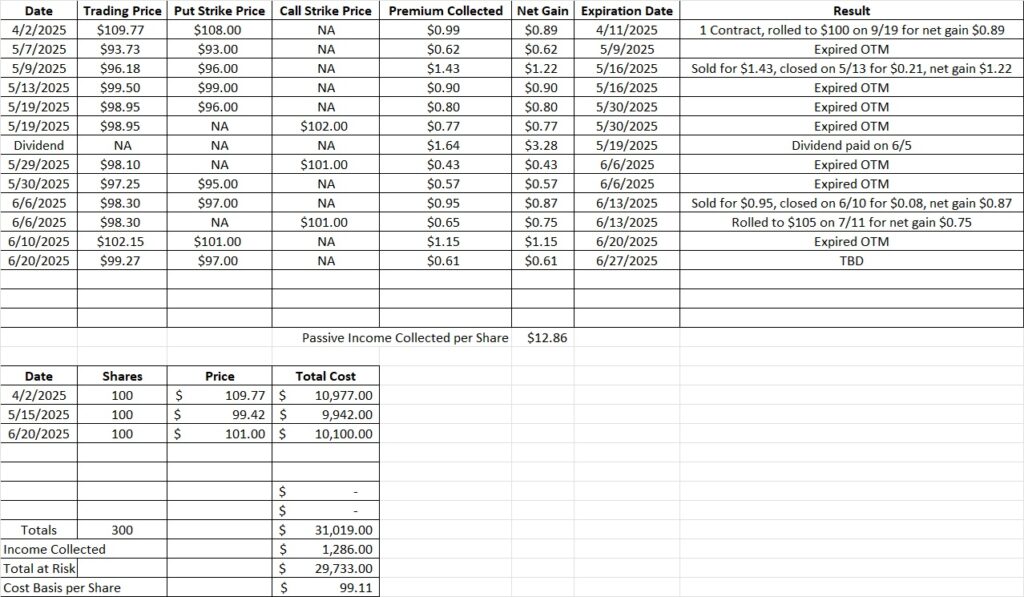
Lately we’ve been using UPS for options trading income. Right now we’re short a few positions on UPS. We have the covered call for the 7/11 expiration date at the $105 strike and two cash secured put option contracts. We have the $100 put for the 9/19 expiration date and the $101 strike that expires today, 6/20. Here is a link to our most recent trade on UPS.
We sold to open the $101 cash secured put option contract last week and right now UPS is trading at $99.29. That puts our put option contract in the money. Now we’re obligated to buy 100 shares at $101 at market close today, or we could roll the position. If we roll the position we’ll buy back this put option contract. Then we’ll sell another one at a lower strike price with an expiration date that is further out in time. We can also take the shares at $101, because we wouldn’t have sold the put at that strike if we weren’t ok with buying the shares there. Keep in mind that we like UPS as a company to hold for the long term. Let’s walk through the decision and show how we use options trading income to reduce our basis.
We feel it’s undervalued and it has a solid dividend yield of 6.6% at the $99 trading price. We’re familiar with the event that’s dropped its trading price including recession concerns, the drop in revenue due to reducing their Amazon business and the Trump Tariff uncertainty. We currently own 200 shares of UPS with a basis of $98.47 per share. We have room for a total allocation of $60,000 to UPS in this portfolio. Right now we have just under $20,000 allocated, plus the two put option contracts. If both put option contracts are assigned that will give us a total of 400 shares with a total allocation of just under $40,000. So we have room to take shares here at the $101 strike. UPS is likely to have another dividend around 8/18, so we have about two months to get another tranche in.
We could also roll the put option trade. To do that we would buy to close the $101 put for $1.90. We brought in $1.15 when we sold to open the trade. So we take the $1.90 to close the trade and subtract that from the $1.15 we brought in and that gives us a loss of $0.75 that we need to make up to at least break even. We could sell the $98 put strike for next Friday’s expiration, 6/27 for $0.96, which would net us a gain of $0.21 on the set of trades. We could also sell to open the $99 put option for the 7/11 expiration date for $2.27. That would give us a net gain of $1.52 on the trades. That sounds better. But it would also mean that we’d still only have 200 shares of UPS. We’d like get another tranche sometime soon.
Another factor for options trading income is that we can sell a covered call on the shares. If we take the shares at $101 we can then sell the $101 covered call. Since we have 200 shares in our portfolio and we only have one call active right now, we have 100 shares that are unencumbered. We can sell the $101 strike on the covered call today for next Friday’s expiration date, 6/27. We’ll be assigned 100 shares at the $101 strike, so even if UPS runs up aggressively and we lose both of our covered calls, we’ll still have 100 shares. If UPS does run up we’re likely to roll the covered calls so we can keep shares. There appears to be a resistance level around $99. There’s a chance that holds and UPS ascends next week. If not, we’re happy to hold these shares and collect the dividend.
We’re going to take the shares at $101. UPS has dropped slightly each of the last three trading days and is sitting on a resistance line. We’re optimistic for a bounce next week, and if we get that we’ll sell a covered call.
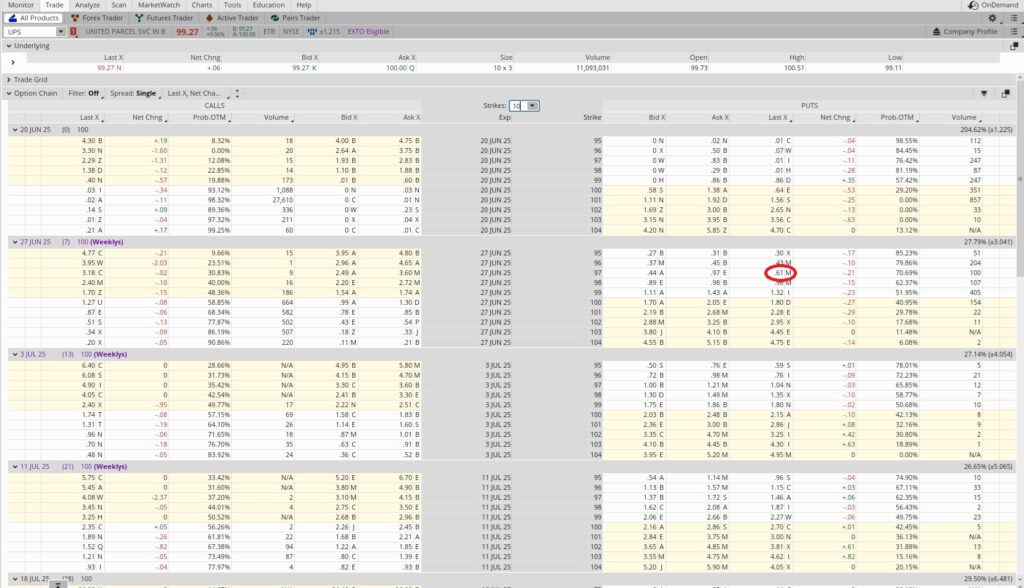
We also sold to open another cash secured put option on UPS. This one is for the $97 strike for the 6/27 expiration date. When we evaluate choices for options trading income we use this options trading calculator. Since we’re selling to open one contract we’re making a promise to buy 100 shares at $97 on or before next Friday.
We need to have at least 100 x $97, or $9,700 available in our brokerage account to make this trade. We brought in $0.61 in options premium when we sold to open this contract. That’s a total of $61. This trade has one week to go before it expires. There are 52 weeks in a year, so our time multiplier is 52. Then we divide the option premium of $0.61 into the strike price of $97 and we get 0.0063. We multiply that 0.0063 by the 52 times in a year we could do this trade, and we get 0.327. That’s an annualized return of 32.7%. That works for us.
The put and the covered call give us options trading income on both sides of UPS. If UPS continues to trade above $97 we won’t have the obligation to buy shares. And if UPS stays below $105 through 7/11 we won’t need to worry about having any shares called away. Either way, we’ll keep the options premium for cash flow.
Weekly Option Trade Recap
We’ll take the shares on our $101 put option that expires today. Then we sold to open the $97 put option for the 6/27 expiration date for $0.61 in option premium. These moves bring our position in UPS to a total of 300 shares with a basis of $99.11 per share.