Passive Income Plan for 2026
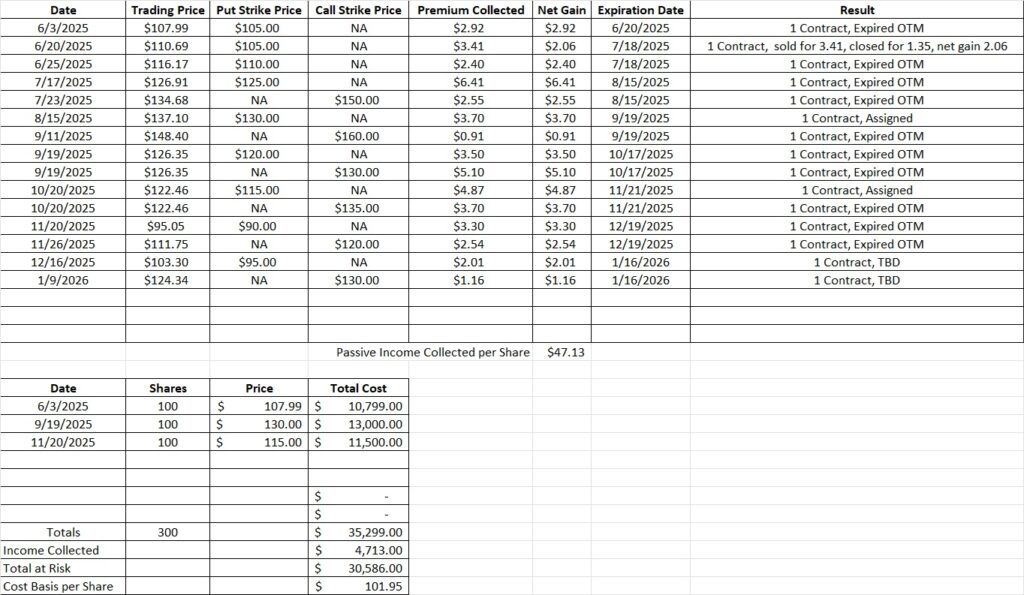
Today we’re going to walk through our passive income plan for 2026. Recently we’ve been trading BLDR. We currently hold 300 shares of BLDR in this portfolio and we’ve worked our basis down to $101.77 per share. We’re only trading BLDR because we’re happy to own shares for the long term. With BLDR trading at $124.34 right now we’re in a profitable position with this investment. We currently hold a cash secured put option contract with an expiration date of next Friday, 1/16. That gives us the obligation to buy 100 shares of BLDR at the $95 strike price on or before expiration on the third Friday of the month. When that contract expires next Friday we’ll think about selling to open another put option with a similar strike price. But a lot can happen with price movements in the stock market between now and next Friday.
There are several factors in our decision to trade options as part of a passive income plan. That includes our risk tolerance with our trading plan and our options strategies. There are two types of options contracts, puts and calls, and we can buy or sell them. We focus on selling the option contracts to collect the option premium as passive income. We sold to open the $95 put option back on 12/16 and we brought in $2.01 in passive income. That contract expires next Friday, the third Friday of the month. We wait for the time decay value of the option premium to run its course until the contract expiration date. At that point we’ll either buy shares at our strike price or the option contract will expire worthless. When the option expires the capital for the cash secured put option will become available again.
We have capacity for a total allocation of $60,000 to BLDR in this portfolio. So we have room to take shares on our $95 put option contract, but with BLDR trading over $122 right now it appears less likely that our put will go in the money. With BLDR’s run up these last few days we’re going to sell a covered call option on some of our shares. We’re only going to sell one contract, because if BLDR continues to run up we want to hold some shares for the long term. We think BLDR is likely to perform better over the next couple years. Links to some of our recent options trades for passive income on BLDR are available here, here, here and here.
This trading strategy entails selling a put option contract with a strike price below the trading range to collect premium. We also sell to open a covered call option contract with a strike price that is above the trading range. That gives us additional premium as passive income. BLDR has monthly option contracts so we’ll take advantage of those. If BLDR had weekly option contracts we would use those instead. A more detailed overview of this passive income plan is available here. An important factor when selecting a company for trading stocks is we only trade a company we want to buy and hold for the long term.
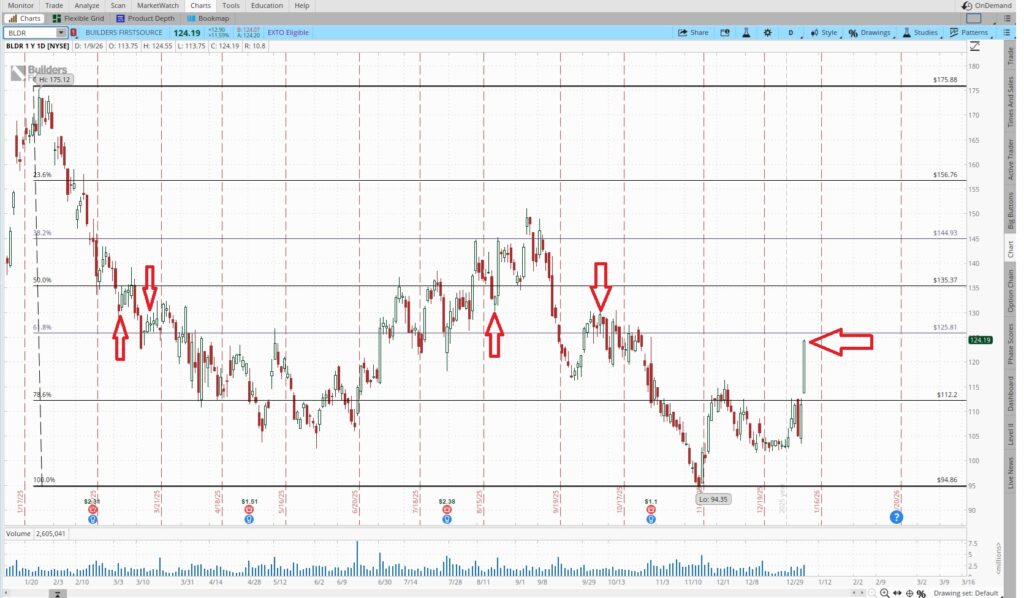
When we select our strike for the covered call we want to be far enough above the current trading range to make it unlikely our option contract goes in the money. When we sell a covered call we’re making a promise to sell our shares at the strike price on or before the expiration date. We like to use a one year chart with daily candles to search for resistance lines that are in our favor when we select our option strike price. In this example we’ll show how options trading works for beginners.
In the chart below we can see a green candle with today’s price movement. BLDR opened the day at $113.75 and is now trading at $124.19. That’s a big move up, and it’s well above our cost basis. With a big run up like that we can get more premium selling a covered call above the money that we would if the price were more stable. BLDR has option strikes in $5 increments. We bought our highest tranche of BLDR at $130, so we want our strike price to be at least that high. We’d like a cushion between our strike and the current trading price to make it more likely our covered call option contract expires out of the money. We can also see resistance around $130 that has stalled price moves a few times over the last year. So we’ll target the $130 strike or higher.
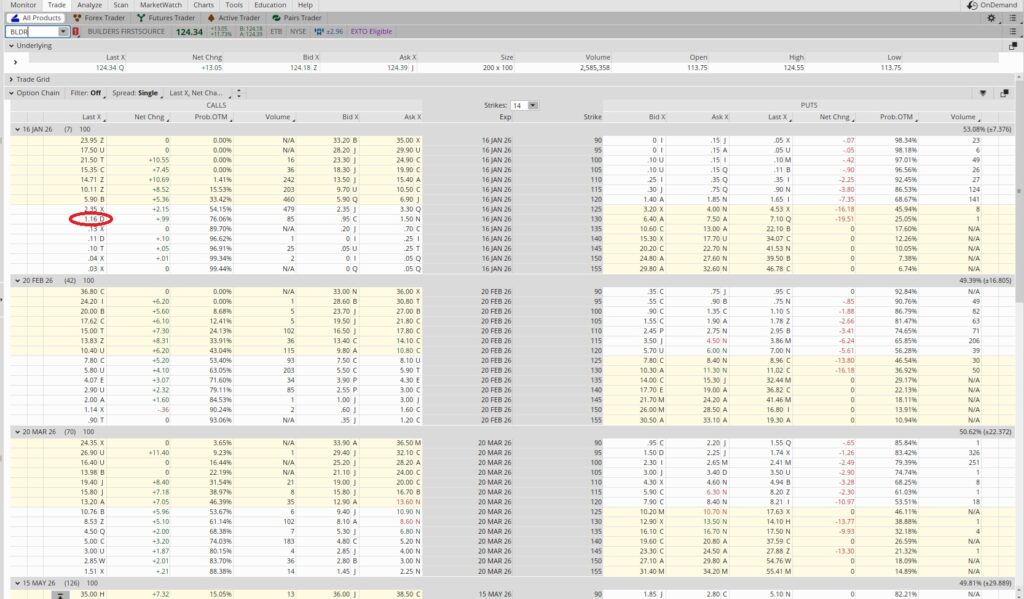
Let’s start with the $130 strike. We can see the mark for the $130 strike on the 1/16 expiration date is $1.16. That’s with the current Bid of $0.95 and Ask of $1.50. The $130 covered call for next Friday is a seven day trade, or a duration of one week. Thee are 52 weeks in a year, which makes our time multiplier 52. We divide the premium of $1.16 into our $103.01 cost basis and we get 0.011. Then multiply that by our time multiplier of 52 and we get 0.586. That’s an annualized return of 58.6%. That’s solid. But what’s the level of risk, and does it fit with our risk tolerance?
The risk is that BLDR continues to run up and we need to sell our shares at $130. The effective sale price would be $130 plus the $1.16 in option premium, or $131.16 per share. That’s more than we paid for the shares. We’d be making money on the trade if it goes in the money. We could also adjust the position so we would not need to sell our shares. To do that, we would buy to close the in-the-money covered call option contract. Then we would look for another covered call with a strike that is higher up, at say $140 or $150, and that is further out in time. We would want the expiration date to be far enough away that the option premium would cover what we paid to close the existing option contract. We could also just let the shares go for a profit.
Now let’s look at the strike price that is the next one higher. The $135 strike had a Bid of $0.20 and an Ask of $0.70, also for the 1/16 expiration date. Assuming we can fill that contract for $0.40 the annualized return would be about 20%. That really isn’t enough premium to make it worthwhile to sell the contract.
We could also go with the 2/20 expiration date, which is 42 days from now. We can get quite a bit further from the money by going that far out in time. Since an option contract with that expiration date will run for 42 days, we divide the 365 days that are in a year by the 42 days the contract would be active. That gives us 8.7. Now let’s look at the strikes and the premium for each. We can see the $140 strike has a mark of $2.90. So we divide $2.90 by our $103.01 basis and we get 0.028. Then we multiply that by our 8.7 and we get 0.245. That’s an annualized return of 24.5%, if we were to do a similar trade every period over the course of a year. That’s not very good, so let’s go a step closer to the money.
The $135 strike for the 2/20 expiration date has a mark of $4.07. We divide the $4.07 by our cost basis of $103.01 strike price and we get 0.0395. Then we multiply that by our time multiplier and we get 0.344. That’s an annualized return of 34.4%. That’s less than the 58% on the $130 strike for the 1/16 expiration date and it’s also six weeks away vs one week. It’s also $5 further away from the money. So we would rather go six weeks with a 34% annualized return or one week with a 58% annualized return? Let’s dig a little deeper.
We can see that BLDR has their 4Q25 earnings call scheduled for 2/19. That means we’ll need to ride out an earnings call before the 2/20 expiration date. We can see that BLDR had a large move on the dates of their last two earnings calls, on 10/30 and 7/31. That could easily happen again. So while the 2/20 expiration date gets us $5 further from the money, the contract goes for six weeks vs one week. It also goes through an earnings announcement and gives us a lower rate of return. Here’s the option contract annualized return calculator we use. And here’s the cost basis tracking template we use.
Weekly Option Trade Recap
We currently hold a cash secured put option for the 1/16 expiration date at the $95 strike. That contract looks like it will expire out of the money. We’ll let it expire, then explore selling to open another cash secured put option when we have access tot hat capital again. Today we sold to open a covered call option contract at the $130 strike price for the 1/16 expiration date. That passive income plan gave us $1.16 in passive income and brough our basis down to $101.95 per share.