
Choose a Company for Investing
When we choose a company for investing in the stock market we want to minimize our risk. We could choose an index fund or an individual company with our long term passive income strategy. Today we’re going to walk through how we benchmark the professional managers of large hedge funds. By watching the professionals we can make it more likely that we choose a strong company for investing. A key factor in this passive income strategy for accredited investors is choosing a solid company with a long runway. We’ll use that company to create consistent monthly cash flow with weekly options trades. Let’s walk through that process.
Each quarter fund managers with at least $100 million in investable capital must file a 13F with the SEC. The 13F shows the activity of the fund for the quarter. Hedge funds have 45 days after the close of the quarter to file their 13F form. For the first quarter, which ended on 3/31, 13Fs are due on 5/15. Now we can research those filings. Just because we see a company listed in the 13F filing from a hedge fund does not mean we should buy that company. Instead, we use the 13Fs as a starting point for our research. We’ve compiled a list of fund managers with an investment style that is similar to our approach. We use a value investing approach with a slant toward companies in the United States.
We review the filings for each of the fund managers we follow using the tracking tool here. Preferably we see more than one of the fund managers we follow adding shares of the same company. That could be starting a new position or adding to an existing position. We’d also like those purchases to be a significant portion of the fund manager’s portfolio. Generally, when we see more than one fund manager adding 2% or more of their capital portfolio to the same company, we’ll do more research on the company to see if we’d like to pursue it. The larger the percentage of the fund manager’s capital allocated to the company, the more confident the fund manager is that the company will outperform in the long run. Here’s more detail on the approach.
We may choose a company for investing even if only one fund manager holds a position. If that company represents a larger portion that fund’s capital we may research that company. We also like to see that there are not any funds that are currently selling shares of that company. When we sort through the fund manager purchases we also look at the overall volume of shares purchased and sold by the larger fund managers. Here is a chart showing the total volume of shares purchased and sold by fund managers over the last several quarters. We can see the number of shares purchased has increased over the last several quarters.
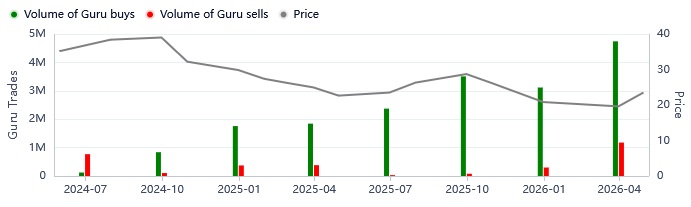
Let’s also look at it another way:
Quarter End: Shares Bought: Shares Sold:
3/31/25 1,843,695 381,021
6/30/25 2,372,381 30,513
9/30/25 3,508,051 78,027
12/31/25 3,115,409 298,016
3/31/26 4,741,450 1,176,495
We can see that the ratio of buys to sells is 3 or more to one. This is quite lopsided on the buy side, so the company is a candidate for us to do more research.
Now let’s look at another example. Last fall we began selling options for income on CROX and we’ve been doing these cash flow options trades each month. We have some recent articles on those trades here and here. We can see the buying volume has increased significantly on CROX over the last few quarters. The most recent quarter was a ratio of 14+ shares purchased for each share sold. The prior quarter was a ratio of 5 to 1. So while we’ve already established a position in CROX, it’s nice to have the validation that the experts continue to like the company.
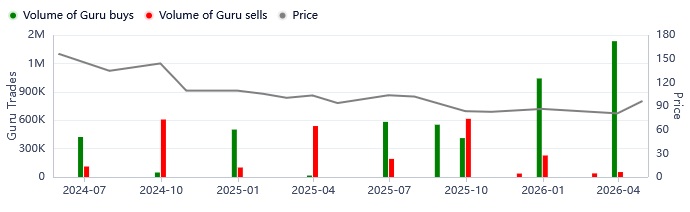
Quarter End: Shares Bought: Shares Sold:
6/30/25 582,392 191,219
9/30/25 963,423 614,535
12/31/25 1,040,706 263,500
3/31/26 1,434,802 90,489
Once we’ve identified some companies through the 13F filing process we start our research. Here’s more information on that process. Some quarters give us a few companies to start trading, other quarters don’t give us any. Using the 13F filings points us in the direction of the professional money managers, which improves our chances of success.
Once we choose a company for investing that’s trading in a favorable price range we’ll begin to sell options for income. Our profitable stock trading strategy includes selling to open a put option just below the current trading price. When we sell to open a put option we’re making a promise to buy shares of the company at the strike price of our put option contract.
Once the contract is active we’ll have the obligation to buy shares of the company at the strike price on or before the expiration date. We’ll collect the option premium as passive income and wait as the time decays through the expiration date. If the option expires out of the money we’ll sell another put option and collect additional premium. We’ll continue selling puts to collect consistent monthly cash flow until the price movement of the company drops through our strike price and we buy shares.
When we start this options trading strategy on a company we begin by using only part of our capital. If the trading price drops we want to be able to dollar cost average into the position. This article gives more detail on why allocating capital in pieces is an important part of the strategy. Once we own some shares we’ll continue to sell put option contracts below the trading price to collect more option premium. We’ll repeat this process until the trading price rises to a point where we no longer find the company trading at an attractive price, until we’ve filled several tranches, or until something changes in the market, industry or company that makes us no longer want to acquire shares of the company. Here’s more detail on how this trading plan works.
We’ll also sell to open covered call option contracts on a portion of our shares. We sell that call option at the strike price we purchased the shares. Selling a put option and a call option on the same company at the same time is know as a ‘Strangle’. Since we’re selling to open the contracts, it’s referred to as a ‘Short Strangle’. We only sell call options on a portion of our position because we want to hold some shares for the long term. If the trading price of the underlying security runs up through our call strike price we can let the shares go and still hold some shares. Selling puts and then selling calls on the shares once assigned is known as a ‘Wheel Trade Strategy’.
We use the options income from the put option contracts to create consistent income while we accumulate shares of the company. Once assigned, we generate additional cash flow by selling covered call on those shares. That option premium means we’re able to create cash flow even if we buy and sell shares at the same strike price. We use the 13Fs when we choose a company for investing to be sure the expert investors with large amounts of capital are also accumulating shares.