Easy Options Trade Example
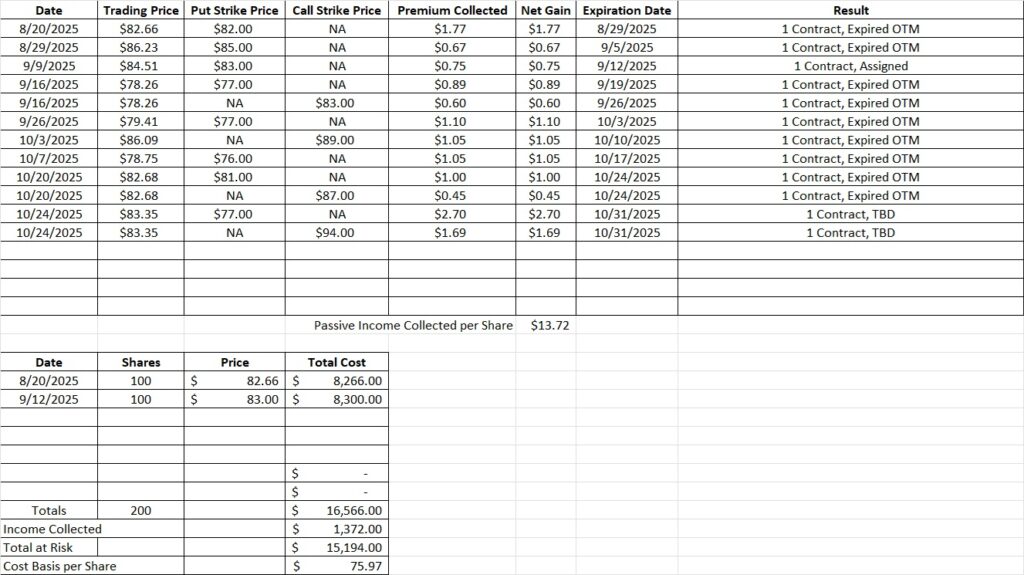
This easy options trade example walks through an options trade strategy we’ve been using lately. We currently own 200 shares of CROX in this portfolio with a basis of $78.17 per share. We have a cash secured put option contract at the $81 strike that will expire out of the money worthless at market close today. Also in our portfolio is a covered call at the $87 strike that will expire out of the money at market close today. On both of those contracts we’ll keep the option premium as passive income. We’ll also have access to the capital we’re using on the put option again. We have space for four more tranches of CROX in this portfolio so the capital requirement for selling another put isn’t an issue for us right now. Here are links to some easy options trade examples on our CROX holdings.
CROX has their quarterly earnings call next week, and that heightens the options volatility. That means we can get a lot of premium, much more than normal, by selling some option contracts right now. We want to be sure we’re comfortable with our buy price when we sell to open a put option contract that goes through the earnings call. Since our basis right now is $78.17 we’d like our put strike to be lower than that. That way we’ll reduce our basis if the trading price drops and we’re assigned shares. If we’re not assigned shares, we’ll still lower our basis because of the option premium. We’re ok with buying shares here because we’ll be getting shares at a price we’re comfortable paying. If we don’t get assigned shares we’ll just collect the premium and then sell another put when this contract expires.
When we sell to open a put option we’re making a promise to buy shares of the company at the option strike price. We can be assigned shares at any time up until the contract expires at market close on the expiration date. When we make that promise to buy shares, we need to have enough capital available in our brokerage account to take the shares. Each option contract represents 100 shares. That means selling a put option at the $77 strike requires $7,700 in capital available in our brokerage account. We won’t have access to that capital again until the contract expires, so we want to be sure we’re getting a solid return on our capital. Let’s walk through this easy options trade example.
Since we’re accepting some risk by making a promise to buy shares we want to get a high enough return to justify our risk. For us, that means we need to get an annualized return of at least 20% on our capital. We have two components to factor when we sell to open a put option. The first is the duration of the contract. Today in 10/24 and the contract we’re looking at expires on 10/31, which is one week away. There are 52 weeks in one year. That means we could do this trade, or a similar trade on another company, 52 times in a year. So our time multiplier is 52.
Then we look at the capital we’re risking and compare that to the revenue we’re bringing in. The capital at risk is the strike price, which is $77. The option premium we’ll bring in for selling to open the put option is $2.50. So we divide the option premium of $2.50 into the $77 strike price and we get 0.032. Then we multiply that by the time period the trade is active, in this case 52, and we get 1.69. This easy options trade example yields an annualized return of 169%. We usually wouldn’t get that high of return for selling a put that is over 7% below the current trading price. In this case the option premium is higher than normal because of the earnings call coming up next week. Here’s the option contract return calculator we use.
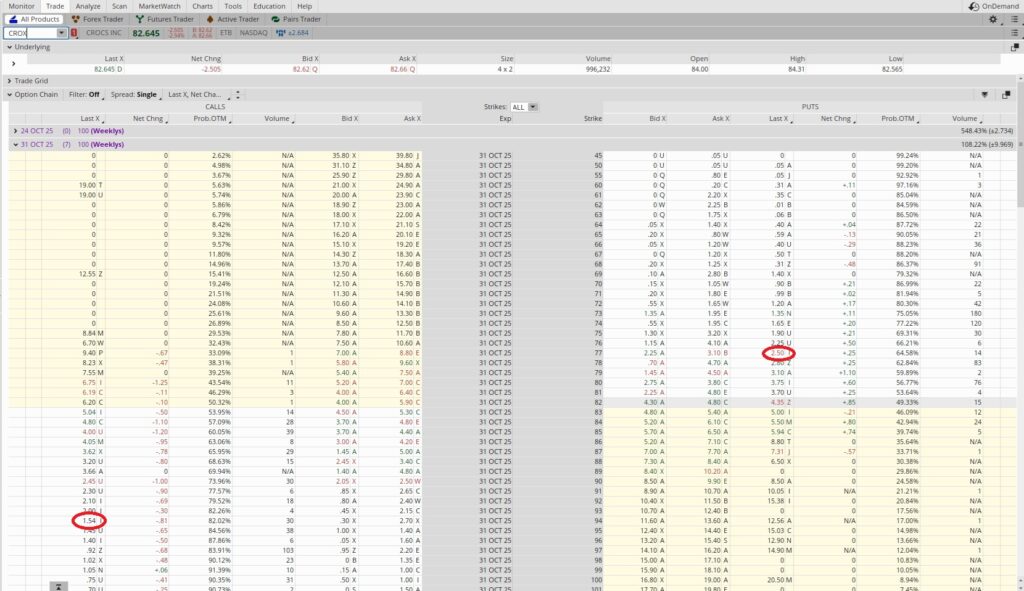
We’re also going to sell to open a covered call option contract. Since our cost basis is $78.17 per share we can sell a covered call at any strike higher than that. If our shares are called away we’ll make money on the sale of the shares. If the trading price stays below our call strike we’ll keep our shares. Either way, we’ll keep the option premium we bring in when we sell to open the call option contract. The additional premium due to the upcoming earnings call means our call strike can be over 10% above the trading price and we’ll still generate some decent premium. We sold to open the $94 call strike for the 10/31 expiration date for $1.54 per share.
Weekly Options Trade Recap
We own 200 shares of CROX in this portfolio with a basis of $78.17 per share. The two easy options trade examples we walked through included both a cash secured put and a covered call option. We sold to open the $77 cash secured put option for the 10/31 expiration date for $2.50 per share. We also sold to open a covered call at the $94 strike. Our covered call shares the 10/31 expiration date. These two trades give us a total of $4.04 in option premium, and that reduces our overall basis on CROX down to $75.97 per share. Here are examples of similar trades we’ve done on other companies. Here’s the option trade history template we use to track our cost basis.